
1. Why the pipe count decides the thermostat
Ask a manufacturer for a “fan coil thermostat” and the first technical question back is not about Wi-Fi or screens — it is two-pipe or four-pipe? The water-side architecture of the fan coil system determines how many valves the unit carries, how the thermostat must change over between heating and cooling, and what happens in the weeks of the year when the building cannot make up its mind about the season. Get the architecture and the thermostat capability out of step and the symptom is always the same: cold complaints in June, warm complaints in October.
This guide covers both systems end to end — plumbing, valve counts, thermostat behaviour, the changeover problem and its solutions — so that the specification sheet matches the building. For wiring-level detail afterwards, see our FCU thermostat wiring field guide.
2. Two-pipe systems: one circuit, one season at a time
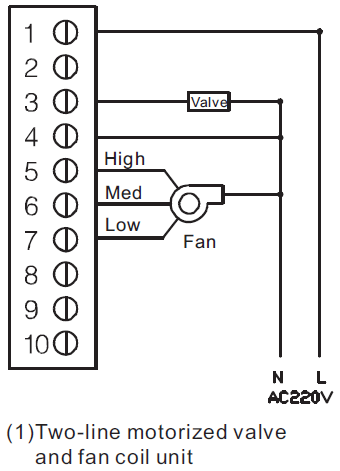
A two-pipe fan coil unit has one supply and one return. The whole loop — and typically the whole building — carries either chilled water or hot water, switched at the plant over the seasons. Each FCU has a single control valve, and the room thermostat performs a simple duty: run the fan (and often the valve) when the room needs what the loop is currently supplying.
The architecture is cheap: half the pipe runs, one valve, one actuator, simple thermostats. The cost appears at the shoulders of the season. When the loop runs chilled water but a cold snap puts a south-facing office into heating demand, that unit simply cannot comply — the thermostat can command all it likes, the water is the wrong temperature. The industry name for the result is “shoulder-season complaints”.
2.1 The changeover problem, precisely
Two-pipe operation has three phases: heating season, cooling season, and changeover. The plant switches the loop — and the risk window is everything around that day. If thermostats still believe the loop is hot when it runs cold, cooling calls open the valve and blast cold water onto rooms that wanted heat; the reverse is worse in practice because chilled coils sweating onto warm air and vice versa both produce complaints. Two-pipe systems therefore need a deliberate, communicated changeover procedure.
3. Four-pipe systems: two circuits, no compromise
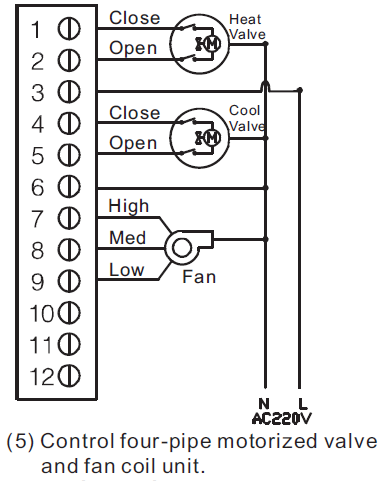
A four-pipe unit carries a chilled-water pair and a hot-water pair; the coil is either split (two separate coil sections) or a common coil section with two headers. Each circuit has its own valve — two valves per unit — and the thermostat modulates whichever circuit the room needs, whenever it needs it. Simultaneous heating and cooling is the whole point: perimeter offices in sun and interior meeting rooms in shade are both satisfied from the same plant at the same hour.
The price is in copper, valves, actuators and controls: two valve/actuator sets per unit, thermostats with two outputs and changeover logic, and a plant that must supply both temperatures continuously. Four-pipe is the default in hotels, offices and anything with mixed façades; two-pipe survives where budget rules and the climate is kind.
4. Thermostat capabilities: what each system demands
| Requirement | Two-pipe | Four-pipe |
|---|---|---|
| Valve outputs | One | Two, independent |
| Heat/cool logic | Fixed or switched (manual changeover switch on the stat) | Automatic per room — heat and cool setpoints active together |
| Dead band | Single setpoint ± dead band (loop temperature governs) | Two setpoints with a real dead band (typically 1–2 K) to prevent overlap |
| Changeover input | Yes — a digital input or selector tells the stat what the loop carries | Not needed |
| Fan control | Standard multi-speed | Standard multi-speed |
| Typical failure mode | Stat in the wrong season state after plant changeover | Dead band set too small → both valves open, energy fight |
On two-pipe projects, insist on a thermostat with a changeover input or selector. Building-management changeover by central signal (one contact to every stat) removes the human factor; manual selectors are cheaper and move the human factor onto the maintenance team instead.
5. The mid-systems: three-pipe and beyond
5.1 Three-pipe (common return)
Two supplies (hot, chilled), one common return. Each unit still has two valves, but the mixing of hot and cold return water wastes energy at the plant and strains control valves sized for one temperature. Historically interesting, economically disfavoured — you will meet it in retrofits, and the honest advice is usually to plan its exit, not to optimise it.
5.2 Two-pipe with electric heater
A pragmatic hybrid: chilled water year-round, electric resistance (or hydronic) heat for the shoulder-season shortfall. The thermostat then needs a heating output independent of the water valve, and the electrical infrastructure needs the heater’s real load. Popular in warm climates and in hotels where four-pipe retrofits are unaffordable; the operating cost of electric heat is the trade.
6. Valve and actuator counts per unit
- Two-pipe: one valve (or a valve pair used as one). Thermal or on/off actuators are typical; modulating where coil control quality matters.
- Four-pipe: two valves, two actuators. Budget note: spring-return is rarely needed on FCU zone valves (fail-closed on both circuits is acceptable), which keeps actuator cost down; see the actuator families in our bus-control guide when central monitoring is added.
- Changeover valves: at plant level, two-pipe systems use large motorized or butterfly changeover valves with interlocked sequencing — a plant-side duty, not a room-side one.
7. Choosing by building type
| Building | Recommended architecture | Why |
|---|---|---|
| Hotel guestrooms, mixed façades | Four-pipe | Simultaneous needs between rooms; comfort is the product |
| Warm-climate residential | Two-pipe (+ electric heat option) | Short heating season; budget-sensitive |
| Open-plan office, uniform exposure | Two-pipe acceptable | Rooms rarely diverge; plant changeover manageable |
| Perimeter-heavy office, deep plan | Four-pipe | Sun-side/shade-side divergence is daily, not seasonal |
| Retrofit inside existing two-pipe fabric | Two-pipe + changeover automation | Pipe replacement cost dwarfs controls spend |
8. Frequently asked questions
Can I use a four-pipe thermostat on a two-pipe system?
Yes — use one valve output and enable the changeover input (or the manual selector). Keep the second output spare; it is the cheapest future-proofing available if the building later upgrades to four pipes.
What dead band should I set between heat and cool setpoints on four-pipe?
1–2 K is the working range. Tighter than 1 K invites overlap cycling in rooms with high internal gains; wider than 2 K is felt by occupants as swings. Verify with a week of trend data after commissioning.
How does the thermostat know the loop temperature on a two-pipe changeover day?
Three mechanisms, in ascending order of quality: manual selector, central changeover contact to every stat, or a water-temperature sensor per riser feeding auto-changeover stats. If complaints cluster around changeover weeks, upgrade the mechanism — it is a controls problem, not a pipe problem.
Is two-pipe with electric heater expensive to run?
The electric heat is the most expensive heat in the building per kWh, so the architecture suits climates and buildings where the heat run is short — shoulder seasons in warm regions. Size the electrical infrastructure for the real heater load and let the thermostat interlock fan and heater correctly.
Do four-pipe units need modulating valves?
Not mandatorily — on/off thermal-actuated valves dominate the segment for cost reasons — but modulating valves on the chilled circuit measurably improve part-load control in rooms with high solar gains. Match the thermostat’s outputs to whichever you choose (see our guide to FCU thermostat families).
What is the single biggest two-pipe field mistake?
No owned changeover procedure: the plant switches the loop, nobody switches the stats, and every unit with a stale season state generates complaints. Assign the changeover to a person or a signal — and log it.
Match the thermostat to the pipes with DANRENS
DANRENS is an OEM/ODM manufacturer of HVAC control products from our own facility in Quanzhou, China: FCU thermostats for 2-pipe and 4-pipe duties (changeover inputs, auto-changeover, Modbus/BACnet options), motorized valves and HVAC sensors, with 100% function testing before shipment. Send us the system architecture and we will match the control within 24 hours: contact the DANRENS engineering team.
Related reading: FCU Thermostat Wiring Field Guide · Central AC Thermostat Installation and Wiring · Modbus FCU Thermostat Guide.
Need Help Specifying or Sourcing?
Tell us your system type, required quantity and target market — our engineers reply within 24 hours with matched models and a quotation.
Back to Blog
