2W-250-25 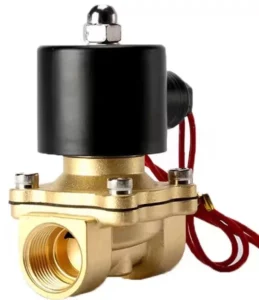


| Model | 2W-350-35 |
|---|---|
| Brand | DANRENS |
| Body | Forged brass, one-piece |
| Function | Normally closed (NC) |
| Connection | 1-1/4 in. (DN32) |
| Orifice | 32 mm |
| Thread bore | 40 mm |
| Rated voltage | AC 220 V or DC 24 V |
| Coil power | 14 W |
| Pressure range | 0-1.0 MPa |
| Fluid temperature | -5 to 80 C |
| Media | Water, oil, air (non-corrosive) |
| Seal | NBR |
| Dimensions (H x W x L) | 172 x 95 x 123 mm |
The 2W-350-35 is the largest standard size of the DANRENS 2W brass solenoid family: a two/two-way, normally closed water valve with a 32 mm orifice on a 1-1/4 in. (DN32) female thread. It keeps the family’s one-piece forged brass body, NBR seal set and 14 W high-copper coil, and extends the same fail-closed on/off behaviour to lines that the 3/4 in. and 1 in. siblings are too small to serve — riser branches, larger manifold feeds and machine cooling headers where the pipe is already 1-1/4 in. and reducing it down would only waste head.
The naming discipline stays the same across the family: orifice and thread grow together, so the 32 mm orifice matches the 1-1/4 in. connection without reducers. Buyers stepping up from the 2W-250-25 or down from a larger spec get an identical coil voltage choice (AC 220 V or DC 24 V), the same media list — water, oil and non-corrosive air — and the same 0–1.0 MPa by −5 °C to 80 °C operating envelope as the 2W-200-20.
A 32 mm orifice changes the hydraulics in the valve’s favour. For a given flow, the larger seat means a lower velocity through the orifice and a smaller permanent pressure drop than the smaller 2W sizes — on a 1-1/4 in. branch serving several take-offs, the valve stops being a meaningful restriction in the circuit. The zero-pressure-differential behaviour of the family also holds at this size: the armature is coupled to the diaphragm assembly, so the valve opens on command from a static line and needs no minimum head to lift, which keeps it usable on gravity-fed and vented circuits as well as pumped ones.
The size that improves the flow also sharpens the one dynamic worth engineering for: closing speed. A solenoid shuts in a fraction of a second, and stopping a moving column of water in a 32 mm pipe that quickly can send a pressure spike back down the line — water hammer — on long, unforgiving runs with high velocity. Three field habits keep it civilised: keep the design velocity reasonable on the branch, avoid ultra-long straight runs slamming directly into the valve, and where the pipework is known to be sensitive, a simple surge arrester or a short accumulator near the valve absorbs the transient. In return for that attention, the valve delivers what no motorised valve can: a guaranteed, spring-less, fail-closed shutdown the instant power is removed.
That is the real decision at this pipe size. If the duty is on/off isolation with a fail-safe default, the solenoid wins on speed, simplicity and fail behaviour. If the duty is throttling, balancing or anything driven by a 0–10 V signal, a motorised ball valve is the correct neighbour — the V6016 motorised ball valve covers modulating duties at comparable pipe sizes, and the reasoning is written out in electric valve vs solenoid valve: differences and functions.
One order decision applies: the coil voltage, AC 220 V for plant wiring with an existing control phase, DC 24 V for 24 V panels, battery-backed controls and machine harnesses. The hydraulic side is fixed by the family ladder — the 2W-200-20 and 2W-250-25 cover the 3/4 in. and 1 in. steps below this model with identical behaviour, so a specification can write “2W series, size to pipe” and be confident of what arrives on site.
Typical DN32 duties are automated fill and make-up lines on larger heating and chilled-water systems, isolation of manifold branches in plant rooms, cooling-water headers on machinery and process skids, compressed-air mains spurs, and light-oil transfer points. The valve suits any of them where the safe state is closed and the control is a simple switched signal; the full-size orifice keeps the pressure penalty small even at the top of the family’s 1.0 MPa range.
The same media boundaries as the rest of the family apply: no steam, no fluid hotter than 80 °C, no corrosive chemistry. Within those lines the valve is a fit-and-forget component — the moving parts are a plunger and a diaphragm, and there is nothing to lubricate or adjust in service.
Confirm four things. Media: water, oil or non-corrosive air, otherwise re-specify the seal and body. Pressure and temperature: the circuit must sit inside 0–1.0 MPa and −5 °C to 80 °C. Connection: 1-1/4 in. pipe takes this valve directly; smaller lines are better served by the correct 2W size than by reducers. Function: on/off with fail-closed behaviour points at this valve, while modulating or balancing duties point at the electric valve range instead.
For a numerical sanity check on water duties, the valve Cv calculator converts required flow and allowable pressure drop into a Kv figure; at DN32 branch flows the 32 mm orifice should clear the figure comfortably, which is the whole point of the full-size seat. The complete switching-valve line-up lives under the solenoid valve category.
Mount with the coil upright and the flow arrow along the pipe, fit a fine strainer upstream so scale and swarf never reach the orifice seat, and leave service headroom above the coil. On a 1-1/4 in. water line the upstream strainer is not optional — the larger the pipe, the more likely the commissioning flush leaves debris behind, and the seat is the one place it must not settle. Thread sealing follows the normal rule: sealant on the male pipe thread only, never on the valve’s female thread.
Wiring is the two flying leads to the switched supply — no polarity on AC 220 V, polarity observed on DC 24 V — with the circuit isolated before work. On long pipe runs known for water hammer, add the surge arrester at installation rather than after the first complaint, and cycle the valve electrically with the line pressurised before handover to confirm the snap-open and snap-close action. Where the valve feeds a line controlled from a building system, the switched signal it needs is the same on/off logic described for damper and valve control in BACnet MS/TP commissioning — a binary output from the controller is all the valve ever asks for.
DANRENS supplies the 2W series for catalogue buyers and OEM/ODM programmes alike. Body branding, packaging and label variants can be matched to machine-builder and skid-builder requirements, and the DN32 size ships alongside the smaller 2W models, the matching motorised valves, thermostats and sensors, so a complete fluid loop can be sourced from one factory. Send the media, line pressure, pipe schedule and coil voltage, and the family can be confirmed against your bill of materials.
A 1-1/4 in. (DN32) female thread with a matched 32 mm orifice, so it goes into a 1-1/4 in. line without reducers. Smaller branch sizes are covered by the 2W-200-20 (3/4 in.) and the 2W-250-25 (1 in.) with identical behaviour.
A solenoid shuts in a fraction of a second, and on long, high-velocity 32 mm runs that fast stop can send a pressure spike back down the pipe. Keep the design velocity reasonable and, on pipework known to be sensitive, fit a simple surge arrester or accumulator near the valve. Most branch installations close without any measurable hammer.
Choose the solenoid for on/off isolation with a fail-closed default - the 2W-350-35 shuts instantly and needs no power to stay closed. Choose a motorised ball valve such as the V6016 when the duty is throttling, balancing or 0-10 V modulating control.
Fluid from -5 C to 80 C. That covers cold and ambient water, oils and compressed air, but excludes steam and hot water above 80 C - a steam line needs a dedicated steam-rated valve, not this family.
Only the hydraulics: a 20 mm orifice on 3/4 in. (2W-200-20), 25 mm on 1 in. (2W-250-25) and 32 mm on 1-1/4 in. (2W-350-35). Body material, coil family (14 W, AC 220 V or DC 24 V), NBR seals, NC function and the 0-1.0 MPa by -5 to 80 C envelope are identical across the series.
Tell us your required quantity and specifications — we reply within 24 hours.