DTHE-2001 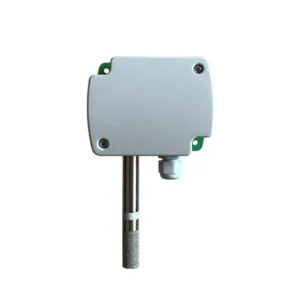


| Model | DSTE-1001 (also referred to as STE-1001) |
|---|---|
| Sensor Type | Duct-mount temperature transmitter |
| Measuring Range | 0–50 °C (A) / -20–80 °C (B) / 0–100 °C (C) |
| Accuracy | ±0.3 °C |
| Resolution | 0.1 °C |
| Response Time | 1 s |
| Output Signal | 0–10 V |
| Operating Temp. | -40–105 °C |
| Operating Humidity | 10–90% RH (non-condensing) |
| Supply Voltage | 15–35 VDC or 24 VAC ±20% |
| Working Current | 12 mA |
| Net Weight | 223 g |
| Housing Material | PC |
DSTE-1001 is a duct-mount temperature transmitter for HVAC and industrial automation. A high-precision sensing probe is inserted through the duct wall into the air stream, and the electronics behind it convert the probe’s output into a standard 0–10 V signal using a PIC microcontroller for linearisation and filtering. The result is a transmitter that a building management system or a controller can read without any additional signal conditioning.
The housing is PC and the unit is designed for permanent installation in an air handling unit, a duct run or a pipeline. A 304 stainless-steel thermowell sleeve is available as an option, which allows the probe to be withdrawn for service or calibration without breaking into a pressurised or a running system. Because the sensing element is exposed to the air stream rather than mounted against a wall, the model measures air temperature where it actually matters in a duct-based system.
The sensing element changes its electrical characteristic with temperature, and the microcontroller converts that change into a voltage that is linear across the selected measuring range. Choosing a range, then, is choosing how the ten volts of output are divided: a narrow range spreads the same span over more volts per degree, giving finer effective resolution for the application, while a wide range covers more of the working envelope. That is why the same transmitter is offered in three ranges rather than one — the range should match the process, not the catalogue.
Two figures describe how quickly and how finely the transmitter follows the air. The response time of one second means the output tracks a change in duct temperature without the lag that would make a control loop unstable, and the 0.1 °C resolution means the smallest step the downstream system can see is a tenth of a degree. Because the device is a transmitter rather than a switch, it carries no set point and no relay: it reports the duct temperature continuously and the controller decides what to do with it.
Three measuring ranges cover the usual duties. The 0–50 °C range suits comfort cooling and heating air, where the duct temperature stays inside the occupied envelope; the -20–80 °C range covers mixed air, preheat coils and systems that must operate with outdoor air below freezing; and the 0–100 °C range covers hot-air and light process duties. The range is an order-time choice, and the sensor range selector helps match a range to the working envelope of the application.
The optional 304 stainless-steel thermowell is the second choice. Where the probe is fitted into a pipeline, or into a duct that cannot be shut down for maintenance, the sleeve allows the sensor to be removed and replaced without opening the system. The supply is 15–35 VDC or 24 VAC, which covers the common panel supplies, and the current draw is low enough that a single loop supply can feed several transmitters.
The model is used for building automation and HVAC signal acquisition, greenhouse climate control, and pharmaceutical or chemical process monitoring — anywhere a duct or pipe air temperature has to be reported to a controller as an analogue signal. In an air handling unit it typically measures supply, return or mixed air temperature; in a greenhouse or a process enclosure it measures the conditioned air leaving the plant.
Because the probe reaches into the air stream, the transmitter is also the appropriate choice where a wall-mounted sensor would measure the wrong air: a large duct, a plant room where the air stratifies, or a pipeline where the medium temperature is the variable of interest. The distinction between duct and room sensing is a siting decision rather than a specification one, and it is worth settling before the instrument schedule is issued.
Four questions cover most projects. First, what is the working envelope — if the duct can see outdoor air below freezing, a range that starts below zero is required, and a 0–50 °C transmitter will simply saturate at the bottom of its span. Second, how will the controller scale the signal, because the scaling has to match the range ordered; the analog signal calculator converts between a physical value and the voltage a 0–10 V loop will present.
Third, is a thermowell needed, which follows from whether the installation is in a pressurised line or a duct that cannot be stopped for maintenance. Fourth, and most often overlooked, is where the probe will sit in the duct. A probe immediately downstream of a coil or a fresh-air intake can sit in a stratified layer that is not representative of the air the system is actually delivering, and no amount of transmitter accuracy compensates for that. The choice between transmitter types is discussed further in PT100 vs NTC vs digital output, the signal conventions are set out in HVAC control signals: 0–10 V and 4–20 mA, and the alternatives in this catalogue are collected under the sensor range.
Choose a probe position where the air is well mixed and where the probe length reaches past any boundary layer at the duct wall — typically a straight run rather than directly after an elbow, a coil or a fan discharge. The arrow on the probe, where fitted, indicates the intended direction of insertion relative to the air stream. Seal the duct penetration so that the measurement point is not disturbed by leakage, and keep the probe clear of any obstruction that would shadow it from the main flow.
Electrically, the transmitter is a three-wire device: supply, common and signal. Use screened cable on the signal pair where the run passes close to variable-speed drives or mains conductors, and keep the screen earthed at one end only to avoid a circulating current. Confirm the supply polarity and the range ordered before commissioning, then verify the reading against a reference instrument at a known condition — a check that also confirms the controller’s scaling is correct.
The output is linear across the range ordered, so the temperature is the range’s lower limit plus the fraction of the output multiplied by the span. For a 0–50 °C transmitter, 5 V corresponds to mid-span and 10 V to the top of the range; the same arithmetic applies to the wider ranges. The analog signal calculator performs the conversion for a given range and voltage, which is faster and less error-prone than doing it on a ladder at commissioning.
Match it to the envelope the duct actually experiences. Comfort cooling and heating air fits the 0–50 °C range. Mixed air and preheat applications, or any system running with outdoor air below freezing, need the -20–80 °C range so the transmitter does not saturate in winter. Hot-air and light process duties use the 0–100 °C range. A transmitter that is too narrow is a winter call-out waiting to happen; one that is unnecessarily wide loses effective resolution.
It is optional, and it earns its place in two situations: a pipeline or a pressurised duct, where the probe cannot be withdrawn safely without a sleeve, and any duct that cannot be shut down for maintenance, where the sleeve allows the sensor to be replaced with the system running. Where the duct can be stopped and the pressure is atmospheric, the probe can be fitted directly.
In a straight run where the air is well mixed, past the point where a coil, a fan or an intake has finished disturbing the flow. A probe sitting directly behind a heating coil or in the plume of a fresh-air inlet can report a temperature that is several degrees away from the air the system is delivering, and the controller will then correct a problem that does not exist. Duct penetration seals and correct probe insertion depth matter for the same reason.
Yes. The supply window of 15–35 VDC or 24 VAC suits the standard panel supplies, and the working current is low enough that a single supply can feed a group of transmitters. What has to be kept separate is the signal, not the supply: give each transmitter its own signal conductor back to the controller input so that one faulty loop cannot affect the others.
DNARENS supplies the DSTE-1001 for catalogue orders and as part of instrument packages in which the transmitters, controllers and terminal valves are specified together. Labelling, cable length, thermowell inclusion and packaging can be adapted for OEM and project business, and instruments can be delivered as a schedule matched to the point list on the drawing. Because the output signal and the range are the two parameters that decide whether a transmitter will work on a project, sending the point list with the required ranges is the fastest way to get an accurate quotation. More on our OEM/ODM work is in your reliable OEM/ODM partner for smart HVAC controls.
Tell us your required quantity and specifications — we reply within 24 hours.
