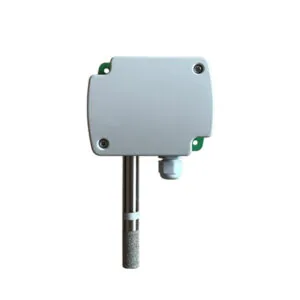
DSTE-1001 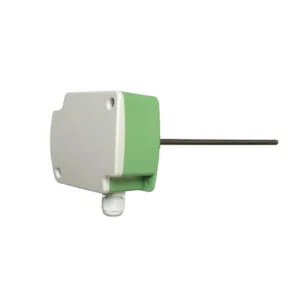


| Sensor Type | Infrared (NDIR) CO2 sensor |
|---|---|
| Measurement Range | 0–2,000 ppm |
| Accuracy | ±40 ppm |
| Power Supply | AC 24 V ±20% or 15–35 VDC |
| Output Signal | 0–10 V |
| Power Consumption | 1.6 W max / 0.8 W avg |
| Sensor Lifetime | 5 years |
| Operating Temp. | -20–105 °C |
| Operating Humidity | 10–90% RH (non-condensing) |
| Net / Gross Weight | 223 g / 332 g |
| Housing Material | PC |
DSAE-2101 is a duct-mount carbon dioxide transmitter for building automation, HVAC climate control, greenhouse monitoring and pharmaceutical or chemical environments. An imported infrared sensing module measures the CO2 concentration in the air stream, and the electronics convert that measurement into a 0–10 V output that any controller or building management system can read alongside its other analogue inputs.
The measurement range is 0–2,000 ppm with an accuracy of ±40 ppm, which is the span and precision that ventilation control needs rather than the wider span a combustion or process analyser would require. The device is a single-purpose instrument: it reports concentration continuously and carries no set point, no relay and no display logic, so the ventilation decision is made by the controller that reads it. That separation is deliberate, because it lets the same transmitter serve a small plant room controller and a large building management system without modification.
The sensing method is non-dispersive infrared, usually abbreviated NDIR. A source inside the module emits broadband infrared, the air sample passes through a chamber, and a detector measures how much of that infrared has been absorbed at the wavelength where the CO2 molecule absorbs strongly. The amount of absorption is proportional to the number of molecules in the chamber, so the reading follows concentration rather than any other property of the air.
Two consequences of that principle matter in a building. The first is selectivity: infrared absorption at the CO2 band is a property of the molecule itself, so the reading is not confused by the other gases that are present in ordinary indoor air. The second is service life. Because the measurement depends on an optical path and a reference rather than on a consumable chemical reaction, the module ages slowly and the published sensor lifetime of five years is the planning figure for replacement rather than a recalibration interval. Where the application depends on the reading — a demand-controlled ventilation strategy, for example — the five-year figure belongs in the maintenance plan from the outset.
The transmitter is supplied in a duct-mount form for a single measurement range, with the probe inserted through the duct wall into the air stream. Its power supply accepts AC 24 V or 15–35 VDC, which covers the voltages normally available at a controls panel, and its consumption is low enough that it can share a supply with other instruments on the same loop.
Because there is one model rather than a range of options, the decisions that usually belong to “configuration” move elsewhere: the range is fixed and matched to the application, and the variables are the mounting point in the duct, the supply taken from the panel, and how the controller scales and acts on the signal. The scaling exercise is the one worth doing carefully, because the whole point of the instrument is that a control strategy responds to the number it reports; the analog signal calculator converts between concentration and the voltage a 0–10 V loop will carry.
The most valuable application is demand-controlled ventilation. A fixed ventilation rate has to be sized for the fullest the space will ever be, so for most of its operating hours it over-ventilates — heating or cooling outdoor air that nobody needed. CO2 concentration is a direct measure of how much of the air in a space has already been breathed, which makes it a usable proxy for occupancy: when the reading is low the controller can reduce the outdoor-air fraction, and when it rises it restores it. In a duct-mounted arrangement the sensor typically sits in the extract or return duct, where it reads a mixture representative of the whole zone rather than one corner of it.
Beyond ventilation control, the instrument is used for indoor-air-quality monitoring and reporting, in greenhouses where CO2 enrichment is part of the growing strategy, and in clean rooms and medical or chemical facilities where the air change rate has to be demonstrated rather than assumed. The relationship between ventilation and indoor air quality, including the role of CO2 as an indicator, is discussed in indoor air quality: the ventilation factor.
The first question is what the measurement is for. If it drives ventilation, a duct-mounted sensor reading the extract air is usually the right choice, because it represents the zone as a whole and it is out of reach of occupants. If it is for room-level display or individual control, a wall-mounted sensor in the occupied space is the appropriate instrument, and this duct model is not a substitute for it.
The second question is the range. Two thousand parts per million covers occupied spaces comfortably: indoor guidance is generally expressed around a thousand ppm, and readings above the top of this range would indicate a ventilation failure rather than a control condition to track. The third question is how the result will be used — reported, alarmed or used to modulate a damper and a fan — because that determines where the signal is terminated and what scaling the controller expects. Signal conventions are covered in HVAC control signals: 0–10 V and 4–20 mA, and the role of sensing within a wider scheme is set out in what is an HVAC control system. Other instruments in the family are listed under the sensor range.
Pay attention to the airflow direction when the probe is fitted: the arrow marked on the probe must align with the actual air flow. An NDIR module measures the air that passes through its chamber, so a probe installed against the direction of flow will read air that is not representative of the duct, or in the worst case will not be swept at all. Choose a straight section of duct where the air is well mixed, seal the duct penetration, and keep the probe clear of points directly downstream of a fresh-air intake where the concentration has not yet equalised across the section.
Electrically the transmitter is a three-wire device — supply, common and signal — so confirm the supply voltage and polarity against the terminal legend before powering it, and run the signal pair in screened cable where the route passes close to variable-speed drives. Commission by checking the reading against a known condition, such as outdoor air at a quiet moment, and then confirm that the controller’s scaling produces the concentration the reference suggests. Because the sensing module has a finite life, it is worth recording the installation date on the schedule at handover.
NDIR stands for non-dispersive infrared. The sensor measures how much infrared light is absorbed by the air sample at the wavelength where CO2 absorbs, and the amount absorbed is proportional to the number of CO2 molecules present. Because the measurement depends on a physical property of the molecule rather than on a chemical reaction, the reading is not disturbed by the other gases present in ordinary indoor air, and the sensing module ages slowly.
For ventilation and indoor air quality in occupied spaces, yes. Guidance for indoor environments is generally expressed around 1,000 ppm, so a range that extends to 2,000 ppm gives useful headroom above the control band, and a reading that reaches the top of the range indicates a ventilation failure rather than a normal condition to regulate. Only specialist process or combustion applications need a wider span, and those call for a different class of analyser.
The transmitter reports the CO2 concentration in the extract or return air, and the controller uses that reading as a measure of how heavily the space is occupied. When the reading is low the controller reduces the outdoor-air fraction — slowing the fan, closing the fresh-air damper or modulating a mixing box — and when occupancy rises and the reading climbs, it restores ventilation. The saving comes from not conditioning the maximum ventilation rate around the clock for a space that is usually only partly occupied.
In the duct when the measurement is used to control ventilation for a zone or an air handling unit, because the extract or return duct carries a mixture that represents the whole zone and the sensor is out of reach. On the wall when the reading is for the occupants of one room or is displayed locally. A duct sensor cannot report what is happening in a corner of a room, and a wall sensor cannot represent a zone served by one air handling unit.
The published sensor lifetime is five years, which is a planning figure for the module rather than a calibration interval. Because the transmitter is usually controlling something — a damper position, a fan speed, a ventilation rate — the replacement date belongs in the maintenance schedule when the device is commissioned, so that the control strategy does not quietly continue on a sensor that has reached the end of its life.
DANRENS supplies the DSAE-2101 for catalogue orders and as part of instrument packages that include the temperature and humidity transmitters, controllers and terminal valves used on the same project. Labelling, cable length and packaging can be adapted for OEM and project business, and instruments can be supplied as a schedule matched to the point list on the drawing. For ventilation-control projects it is worth sending the control intent with the enquiry — whether the reading drives a damper, a fan or a monitoring report — because that determines the scaling and the wiring the instrument has to suit. More on our OEM/ODM work is in your reliable OEM/ODM partner for smart HVAC controls.
It is a duct-mount CO₂ transmitter: the sensing probe sits in the ventilation duct while the housing stays outside the airstream, which makes it suitable for demand-controlled ventilation in AHUs, fresh-air systems and return-air ducts.
It uses an infrared (NDIR) CO₂ sensing element with a 0–2,000 ppm measurement range and ±40 ppm accuracy, outputting a 0–10 V signal powered from AC 24 V ±20% or 15–35 VDC.
Yes — the 0–10 V output connects directly to most DDC controllers and building management systems, not just DANRENS thermostats. See our hospital sensor network case for a deployment example.
Yes. DANRENS provides OEM and ODM service: logo, packaging and hardware or software customization can be arranged based on your order quantity. See how the engagement works in our OEM / ODM guide, or send your requirements through the contact page — our team replies within 24 hours.
Tell us your required quantity and specifications — we reply within 24 hours.