2W-350-35 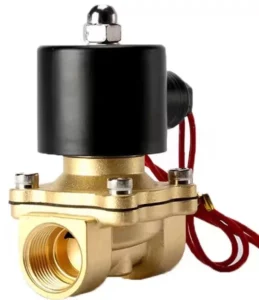


| Model | 2W-200-20 |
|---|---|
| Brand | DANRENS |
| Body | Forged brass, one-piece |
| Function | Normally closed (NC) |
| Connection | 3/4 in. (DN20) |
| Orifice | 20 mm |
| Thread bore | 25 mm |
| Rated voltage | AC 220 V or DC 24 V |
| Coil power | 14 W |
| Pressure range | 0-1.0 MPa |
| Fluid temperature | -5 to 80 C |
| Media | Water, oil, air (non-corrosive) |
| Seal | NBR |
| Dimensions (H x W x L) | 123.5 x 57 x 73 mm |
The 2W-200-20 is a two/two-way brass water solenoid valve with a 20 mm orifice on a 3/4 in. (DN20) female thread. It is the compact member of the DANRENS 2W series: a normally closed, diaphragm-type valve that switches water, oil and air lines with a 14 W coil and nothing more than an on/off electrical signal. The body is forged from brass in one piece, the sealing element is NBR rubber, and the coil is wound from high-copper wire so the valve holds its rated duty without overheating the winding.
The 2W family follows the classic 2W naming logic — the orifice and the pipe connection grow together, so the 20 mm orifice of the 2W-200-20 matches its 3/4 in. thread without any reduction bushings. That one-piece sizing is why the series is so common on machine builders’ drawings: one catalogue line, three thread sizes, one wiring habit. The larger 2W-250-25 and 2W-350-35 share the same body design, coil family and normally closed behaviour, so a panel builder who qualifies one size has effectively qualified the family.
The valve is normally closed: with the coil de-energised, the diaphragm assembly sits on the orifice seat and no flow passes, regardless of how long the supply line sits pressurised. When the coil is energised, the armature is pulled upward and, because the armature is coupled to the diaphragm assembly, the orifice opens directly at low line pressures while the pressure differential across the diaphragm assists the lift as pressure rises. This is why the valve works across its full 0–1.0 MPa rating without a minimum operating pressure — a static, unpressurised line still opens on command, and a fully pressurised line opens without the coil having to fight the full head alone.
Closing is the mirror image and just as decisive. Cut the coil current and the armature drops back under gravity and the return force; line pressure re-seats the diaphragm on the orifice, and the valve shuts in a fraction of a second. That snap action is the practical difference between a solenoid valve and a motorised valve — there is no travel time, no intermediate position and no need for position feedback, because the valve is either fully open or fully closed and always fails to the closed state when power is removed. For a make-up line, a dosing line or a safety interlock, that fail-closed behaviour is exactly what the designer wants; the trade-offs between the two valve families are compared in electric valve vs solenoid valve: differences and functions.
Two order decisions define a 2W-200-20. The first is the coil voltage: AC 220 V suits fixed plant wiring where a control transformer or a mains phase is already present, while DC 24 V suits panels with a switched-mode supply, battery-backed controls or machine-builder 24 V harnesses. The coil is factory-fitted, so the choice is made when ordering rather than in the field. The second is the size itself: within the same family the 2W-250-25 steps up to 1 in. DN25 with a 25 mm orifice and the 2W-350-35 to 1-1/4 in. DN32 with a 32 mm orifice, so the whole hydraulic ladder from 3/4 in. to 1-1/4 in. comes from one design.
The rated media list — water, oil and air, all non-corrosive — covers most of the on/off duties found around HVAC plant and light industry. Typical uses are make-up and fill lines on closed water circuits, condensate and drain interlocks, small pneumatic circuits on machinery, light oil lines on burners and lubrication systems, and automated isolation of branch lines where a valve must close by itself whenever power or the control signal is removed. Because the valve is normally closed, it is at home anywhere the safe state is “shut”: fill valves that must not trickle, dosing points that must not over-deliver, and interlocked supplies that must follow a machine guard or a float switch.
Two boundaries keep selections honest. The fluid temperature window of −5 °C to 80 °C excludes steam and hot boiler water, and the media list excludes corrosive fluids — acids, solvents and seawater need a different seal and body chemistry. Within those boundaries the valve is a fit-and-forget component rather than a maintenance item.
Four answers size the valve. First, media: if the fluid is water, non-corrosive oil or air, the NBR-sealed brass body is correct. Second, line pressure: the circuit must stay within 0–1.0 MPa, which covers municipal water, booster sets down to zero head, and most compressed-air spurs. Third, connection: match the 3/4 in. thread to the pipe — if the line is 1 in. or larger, step to the 2W-250-25 or 2W-350-35 instead of reducing the pipe down. Fourth, coil voltage and control: an on/off signal is all the valve needs, and because it fails closed, the control philosophy must tolerate the line shutting on every power break.
Where the duty calls for throttling rather than switching — a coil that modulates a fan, a balancing task, a valve that rides a 0–10 V signal — the solenoid is the wrong tool and a motorised valve is the right one; the electric valve range covers those duties. For flow checks on the water side, the valve Cv calculator converts a required flow and pressure drop into a Kv figure that can be compared against the valve’s installed position. The full switching-valve line-up, including every size in this series, is collected under the solenoid valve category.
Mount the valve with the coil upright and the body arrow pointing in the flow direction; the armature tube is not designed to work upside-down, and a coil hanging below the body collects debris and moisture around the lead gland. Fit a fine strainer upstream — the moving parts are a plunger and a diaphragm, and a particle trapped on the orifice seat is the one fault pattern that shows up as “valve leaks closed”. Leave headroom above the coil so the unit can be lifted off for inspection without disturbing the pipework.
Wiring is two flying leads to the switched supply: no polarity on the AC 220 V version, polarity observed on the DC 24 V version per the coil marking. Isolate the circuit before touching the leads, and keep the leads clear of hot pipework — the fluid limit is 80 °C and the leads should not be asked to live at it continuously. After installation, cycle the valve electrically at least once with the line pressurised to confirm the snap-open and snap-close action before handing over the system.
DANRENS supplies the 2W series for catalogue buyers and for OEM/ODM programmes. Body branding, packaging and label variants can be aligned with machine-builder requirements, and the series can be shipped together with the matching thermostats, motorised valves and sensors so that an entire fluid loop is sourced from one factory. Send the media, line pressure, pipe size and coil voltage, and the correct 2W variant can be confirmed against your bill of materials.
It is normally closed (NC): with the coil de-energised the diaphragm sits on the seat and the valve blocks flow. When the coil is energised the valve snaps open, and when power is removed it closes again automatically, so the valve always fails to the safe, shut state.
Yes. The valve operates across its full 0-1.0 MPa rating from zero upward because the armature is coupled to the diaphragm assembly, so a static or gravity-fed line still opens on command. No minimum pressure differential is required.
Water, oil and air, provided they are non-corrosive, at fluid temperatures from -5 C to 80 C. Steam, hot water above 80 C, solvents, acids and seawater are outside the NBR-and-brass envelope and need a different seal and body material.
Choose from the panel design, not from the shelf: AC 220 V where a control phase or transformer already exists, DC 24 V for panels with a 24 V supply, battery-backed controls or machine harnesses. The coil is factory-fitted, so the voltage must be stated when ordering; the two coils are not interchangeable in the field.
Fit a fine strainer upstream. The moving parts are a plunger and a diaphragm, and a particle caught on the orifice seat is the most common cause of a slow or leaking close. A strainer costs little and prevents almost all seat-related complaints.
Tell us your required quantity and specifications — we reply within 24 hours.