2W-350-35 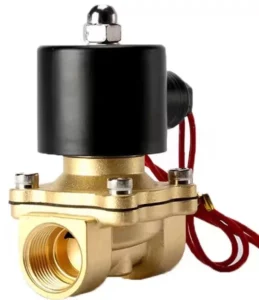


| Model | 2W-250-25 |
|---|---|
| Brand | DANRENS |
| Body | Forged brass, one-piece |
| Function | Normally closed (NC) |
| Connection | 1 in. (DN25) |
| Orifice | 25 mm |
| Thread bore | 32 mm |
| Rated voltage | AC 220 V or DC 24 V |
| Coil power | 14 W |
| Pressure range | 0-1.0 MPa |
| Fluid temperature | -5 to 80 C |
| Media | Water, oil, air (non-corrosive) |
| Seal | NBR |
| Dimensions (H x W x L) | 134.5 x 73.5 x 88 mm |
The 2W-250-25 is the 1 in. member of the DANRENS 2W brass solenoid family: a two/two-way, normally closed water valve with a 25 mm orifice on a 1 in. (DN25) female thread. It carries the same one-piece forged brass body, NBR seal set and 14 W high-copper coil as its smaller and larger siblings, and it switches the same trio of media — water, oil and air, all non-corrosive — across a 0–1.0 MPa pressure envelope and a −5 °C to 80 °C fluid window.
In practice the 2W-250-25 is the workhorse size of the family. One-inch branch lines are the default for apartment risers, small boiler-house manifolds, compressor spurs and machine cooling circuits, so this is the model most panel builders stock first. Where the line narrows to 3/4 in. the 2W-200-20 takes over, and where it widens to 1-1/4 in. the 2W-350-35 keeps the same wiring habit and fail-closed behaviour.
The coil is the only part of a solenoid valve that consumes anything, and on this family it draws 14 W whenever the valve is held open. That figure matters twice. For the electrical designer it sizes the supply: a switched 14 W load per valve is trivial for a control transformer but worth counting when a dozen valves hang from one DC supply in a control panel. For the energy accountant it prices the valve’s habit of being energised exactly as long as the line is open — which is why the NC function pairs naturally with duties that are open for minutes, not hours.
Voltage is chosen at the order stage and the coil is factory-fitted: AC 220 V for plant where a control phase already exists, DC 24 V for panels built around a 24 V switched-mode supply, battery-backed controls, solar-powered pumping skids or machine-builder 24 V harnesses. The two coils are not interchangeable in the field — an AC coil on DC supply or the reverse will not deliver its rated force — so the correct habit is to fix the control philosophy first, then order the coil to match. Panels that mix both worlds simply order the two variants; the valve body, thread and behaviour are identical.
One thermal note completes the picture. A solenoid coil runs warm in normal service, and holding the valve open for long periods is a duty the 14 W winding is built for — but the valve is a switch, not a modulating device. If the process needs the flow to ride between two positions, a motorised valve with a 0–10 V input is the better neighbour; the differences are laid out in electric valve vs solenoid valve: differences and functions.
The order sheet for a 2W-250-25 has one decision — coil voltage, AC 220 V or DC 24 V. Everything else is fixed by the family: the 25 mm orifice, the 1 in. thread, the NBR seals, the NC function. Project buyers who need the same behaviour one size down or up order the 2W-200-20 (3/4 in., 20 mm orifice) or the 2W-350-35 (1-1/4 in., 32 mm orifice) against the same drawing symbol, which is exactly why the series tends to be specified as a family rather than as single valves.
The DN25 size shows up wherever a 1 in. branch needs a reliable on/off point: make-up water fills for closed heating and cooling circuits, boiler-house manifolds with automated fill interlocks, compressed-air spurs feeding production equipment, coolant and light-oil distribution on machines, and irrigation or dosing heads where the safe state is closed. Because the valve opens from zero pressure differential, it also works on gravity-fed or vented lines where a pilot-operated alternative would refuse to lift — a vented roof tank feeding a floor below is enough head for this valve to switch.
The usual media boundaries apply. Steam, hot water above 80 °C, corrosive chemicals and seawater are outside the NBR-and-brass envelope, and duties that need them should be re-specified rather than risked.
Start from the safe state: if the line must shut when power fails, the normally closed 2W-250-25 is already the right family. Then size the connection — the valve’s 1 in. thread and 25 mm orifice are matched, so the valve goes into a 1 in. line without reducers, and lines at other sizes step to the sibling models rather than down through bushings. Check the envelope: line pressure inside 0–1.0 MPa, fluid between −5 °C and 80 °C, media among water, oil and non-corrosive air. Finally fix the coil voltage from the panel design, not from what is on the shelf.
For a quantitative check on the water side, the valve Cv calculator turns a required flow and allowable pressure drop into a Kv figure, which is a quick sanity check that a 25 mm orifice is generous enough for the duty. Where the duty is throttling rather than switching — coil modulation, balancing, 0–10 V control — compare instead within the electric valve range, and for the full switching-valve line-up see the solenoid valve category.
Fit the valve with the coil upright and the flow arrow along the pipe; keep a strainer upstream so the orifice seat and the diaphragm stay clear of scale and swarf, and leave vertical room to lift the coil off for service. The 1 in. thread seals with standard thread sealant or tape applied to the male pipe thread only — sealant on the valve’s female thread finds its way to the seat. Wiring is the two flying leads to the switched supply: no polarity on AC 220 V, polarity observed on DC 24 V, supply isolated before work.
Two commissioning habits pay for themselves. Cycle the valve electrically with the line pressurised and listen for the crisp snap on both open and close — a sluggish close usually means debris on the seat, caught before handover rather than after. And on DC 24 V panels, measure the actual coil terminal voltage with the valve held open; long thin cable runs to remote valves are the usual suspect when a valve chatters or refuses to lift.
DANRENS supplies the 2W series both as catalogue product and inside OEM/ODM programmes: body branding, packaging and label variants can be aligned with machine and skid builders, and the valves can be shipped together with the matching thermostats, motorised valves and sensors so an entire fluid loop comes from one source. Send the media, line pressure, pipe schedule and coil voltage, and the model list can be confirmed against your bill of materials.
The coil draws 14 W whenever the valve is held open and nothing while it is closed, because the valve is normally closed. Count 14 W per energised valve when sizing a control transformer or a 24 V DC supply that feeds several valves.
No. The coil is factory-fitted for one voltage - AC 220 V or DC 24 V, selected when ordering. Both variants share the same body and behaviour, so mixed panels simply order the two variants, but a coil must never be run on the wrong supply.
A 1 in. (DN25) female thread matched to a 25 mm orifice, so the valve fits a 1 in. line directly without reducers. Lines at 3/4 in. or 1-1/4 in. are better served by the 2W-200-20 or the 2W-350-35 than by reducing bushings.
For on/off isolation with fail-closed behaviour - fill lines, interlocks, dosing points - the solenoid is the simpler and faster choice. If the duty is throttling, balancing or 0-10 V modulating control, a motorised valve such as the V2016 is the right tool.
Above the rated 0-1.0 MPa envelope the diaphragm and seat can be pushed past their design limits, causing leaks or failure to reseat. If the supply can exceed 1.0 MPa, fit a pressure reducing valve upstream so the valve always sees its rated range.
Tell us your required quantity and specifications — we reply within 24 hours.