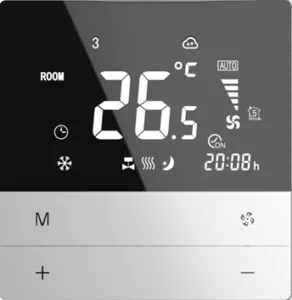
AC818 


| Model | AC006 |
|---|---|
| Power Supply | AC 100-240 V, 50/60 Hz |
| Control Type | Touch button |
| Switching Type | On/Off or 0-10 V (optional) |
| Accuracy | ±0.5 °C |
| Display | Blue backlit LCD, temp + %RH |
| Fan Speed | 3-speed + Auto |
| System Modes | Cool / Heat / Vent / Auto |
| Communication | RS-485 Modbus RTU optional |
| IP Rating | IP30 |
| Application | FCU / Central air conditioning |
AC006 is a touch-button fan coil unit (FCU) thermostat for central air-conditioning systems. Its round blue-backlit LCD shows room temperature, set temperature, relative humidity, operating mode and fan speed on one screen, so occupants read the room condition at a glance instead of stepping through menus. Five capacitive touch keys sit behind a flat 86 × 86 mm faceplate that is surface-mounted on a standard wall box and wipes clean in seconds — a faceplate suited to hotel guest rooms, serviced apartments and offices.
The thermostat works as a complete FCU zone controller rather than a simple switch. It measures room temperature from its built-in sensor, compares the reading with the set point, and then drives the fan relay and the water-side valve together. Switching is available as on/off relay outputs for standard two-pipe and four-pipe installations, or as an optional 0–10 V output where the valve or EC fan must be modulated rather than switched. An optional RS-485 Modbus RTU port lets a building management system read and adjust the thermostat remotely, so the same hardware serves both standalone rooms and supervised floors.
The AC006 holds the space within ±0.5 °C of the set point. In cooling mode, when the room drifts above the set point, the thermostat energises the fan at the chosen speed and opens the chilled-water valve; as the room approaches the set point it closes or modulates the valve, and the fan continues briefly to distribute the conditioned air already held in the coil. Heating mode applies the same logic to the hot-water circuit, while ventilation mode runs the fan alone so a space can be flushed with outdoor air without any heating or cooling demand.
Three manual fan speeds plus automatic fan let the installer choose between the quietest possible operation and the fastest pull-down after a door or window has been open. The weekly timer and holiday mode are what make the AC006 a project model rather than a domestic one: facility staff schedule occupied and unoccupied periods in advance, so a fan coil in an unlet office or an empty guest room is not conditioning an empty space through the night.
AC006 is ordered in three practical combinations. The standard version uses on/off relay switching and suits rooms where occupants adjust the thermostat locally. Adding the 0–10 V switching option makes the output proportional, which is what a project needs when the water side uses a modulating valve, or when a modulating fan is preferred to a three-speed fan. Adding RS-485 Modbus RTU turns the unit into a supervised device on a BMS network. Both optional items are factory options, so they need to be specified at the order stage rather than added during commissioning.
Typical installations are hotel guest rooms and corridors, office suites, serviced apartments and residential central air-conditioning retrofits — anywhere a fan coil unit is zoned room by room and the control point has to look presentable in a finished interior. Because the faceplate fits a standard 86 × 86 mm wall box and the supply accepts AC 100–240 V, the AC006 also drops into refurbishment work where the existing wiring is retained and only the terminal controller is replaced. It is rated IP30, so it belongs on dry indoor walls rather than in plant rooms or wash-down areas.
Three questions narrow the choice. First, how many pipes does the fan coil have — a two-pipe system changes over seasonally between heating and cooling, while a four-pipe system carries separate coils and needs a thermostat that can drive both. Second, does the water side use an on/off valve or a modulating valve, since that answer decides between relay switching and a 0–10 V output. Third, will the building be supervised — if the rooms are to be connected to a BMS or a hotel room-management system, specify the RS-485 Modbus option at the outset.
Two further details are worth settling early. A thermostat with a relative-humidity readout, such as the AC006, is useful where occupants or maintenance staff need to watch moisture levels, while models that display a real-time clock suit rooms that run to a schedule. For water-side sizing, the FCU water flow calculator converts coil load into flow rate and helps confirm the valve Kv to pair with the thermostat; the full FCU thermostat range covers the alternative faceplates and button styles, and the differences between analogue and digital control signals are explained in HVAC control signals: 0–10 V and 4–20 mA.
Mount the thermostat 1.2–1.5 m above the floor on an interior wall that represents the room, away from direct sunlight, door draughts and heat sources such as lamps or supply diffusers — position, not calibration, is the most common cause of inaccurate room control. Use the standard 86 × 86 mm wall box, isolate the circuit before wiring, and keep mains and any RS-485 cabling separated along their runs to avoid interference. Step-by-step terminal details for two-pipe and four-pipe fan coils are given in central AC thermostat installation and wiring, and the commissioning checks that follow are covered in the FCU thermostat wiring and commissioning field guide.
The on/off version switches the fan and the water-side valve with relay contacts, so the circuit is either fully open or fully closed. The 0–10 V version adds a proportional output that positions a modulating valve or a modulating fan across its range, which keeps room temperature steadier and reduces the number of full-flow and full-stop cycles on the water side.
No. Room temperature is measured by the sensor built into the thermostat, so the unit needs only its supply wiring and the fan and valve connections. Where the thermostat cannot be placed so that it sees the occupied zone, a remote-sensing model or an additional wall or duct sensor is a better answer than a badly positioned wall unit.
Yes, when the optional RS-485 Modbus RTU communication board is specified. Without that option the thermostat operates as a local controller: the timer and holiday functions still work, but set points and status cannot be read from the BMS.
The model is designed with that application in mind — a flat touch faceplate that suits finished interiors, child-lock protection to limit tampering, and a weekly timer with holiday mode so that unoccupied rooms are not conditioned around the clock.
The AC3385 uses a square LCD with a clock and suits rooms that run to a schedule; the AC306 and AC308 use black displays with glass or bar touch keys for contemporary interiors; the AC818 is a push-button model for cost-sensitive retrofit work where a tactile button is preferred to a touch surface.
DNARENS supplies the AC series for both catalogue and OEM/ODM business. Faceplate branding, button layout and label variants can be discussed for project and OEM orders, and the thermostat can be supplied together with the matching motorized valves and sensors so that the whole terminal loop comes from one source. Send the room count, pipe configuration, control signal and BMS requirement, and the model list can be confirmed against your schedule.
Tell us your required quantity and specifications — we reply within 24 hours.