AC006 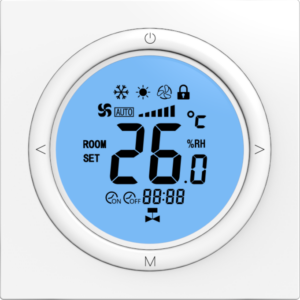


| Model | AC3385 |
|---|---|
| Power Supply | AC 100-240 V, 50/60 Hz |
| Control Type | Touch button |
| Switching Type | On/Off relay |
| Accuracy | ±1 °C |
| Display | Blue backlit LCD, temp + clock |
| Fan Speed | 3-speed + Auto |
| System Modes | Cool / Heat / Vent / Auto |
| Communication | RS-485 Modbus RTU optional |
| IP Rating | IP30 |
| Application | FCU / Central air conditioning |
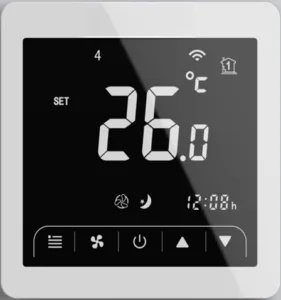
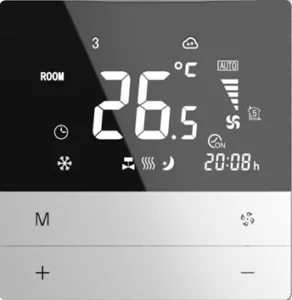
AC3385 is a square-faceplate, touch-button fan coil unit (FCU) thermostat for central air-conditioning systems. Its blue backlit LCD shows room temperature, set temperature, fan speed, operating mode and a real-time clock on one screen, and the five capacitive keys — Mode, Timer, Power, Up and Down — sit behind a flat glass surface with no moving parts to collect dust or to wear out.
The clock is what sets the AC3385 apart from the simpler models in the AC series. Because the unit keeps the time of day and the day of the week, the weekly programme and holiday mode do real work rather than decorating the menu: a facility manager schedules occupied and unoccupied periods once, and fan coils in unlet offices or empty guest rooms stop conditioning empty space through the night. Around that schedule the thermostat performs the ordinary FCU job — read the room with its built-in sensor, compare the reading with the set point, and drive the fan relay and the water-side valve together.
In cooling mode the thermostat energises the fan at the selected speed and opens the chilled-water valve as soon as the room rises above the set point; as the room approaches the set point the valve closes again, and the fan keeps running briefly to distribute the air already cooled inside the coil. Heating mode applies the same sequence to the hot-water circuit, while ventilation mode runs the fan alone so that a space can be flushed with outdoor air with no heating or cooling demand at all. Three manual fan speeds plus automatic fan let the installer choose between the quietest possible operation and the fastest recovery after a door or a window has been left open.
Control accuracy is specified at ±1 °C. That figure is deliberate rather than a compromise: a fan coil cannot modulate its coil temperature the way a variable-refrigerant system can, so chasing a tighter tolerance would mean switching the water-side valve more often for no measurable gain in comfort, at the cost of actuator life. Where a project needs genuinely proportional water-side control, the answer lies in the valve and the output type rather than in the display; the differences between the common signals are set out in HVAC control signals: 0–10 V and 4–20 mA.
Two build options are worth settling before the order is placed rather than during commissioning. The first is the optional RS-485 Modbus RTU communication board, which turns the thermostat from a local controller into a supervised device: set points are written and status is read at the building management system instead of at the wall, which is what makes a floor of guest rooms manageable without visiting each one. The second is the faceplate and key set, which can be varied for OEM and project business so that a hotel group or an equipment manufacturer gets its own button layout and labelling on the same control electronics.
Pipe configuration is the third consideration, and it is settled by the installation rather than by the order. The relay outputs drive a fan and a water-side valve, which covers two-pipe systems that change over seasonally between heating and cooling as well as four-pipe systems whose separate coils are switched by the thermostat. The unit is rated IP30, so it belongs on dry indoor walls rather than in plant rooms or wash-down areas.
Typical installations are hotel guest rooms and suites, office suites, serviced apartments and residential central air-conditioning retrofits — anywhere a fan coil is zoned room by room and the control point has to look presentable in a finished interior. The clock-driven programme makes the model particularly useful in buildings with predictable occupancy, such as corporate offices that empty at a fixed hour, schools and clinics with fixed sessions, and hotel floors that follow a seasonal occupancy pattern.
Because the faceplate fits a standard 86 × 86 mm wall box and the supply accepts AC 100–240 V, the AC3385 also drops into refurbishment work where the existing wiring is retained and only the terminal controller is replaced — a common requirement when an older mechanical thermostat has failed but the conduit behind it is sound.
Three questions narrow the choice quickly. First, how many pipes does the fan coil have — a two-pipe system changes over seasonally between heating and cooling, while a four-pipe system carries separate coils and needs a thermostat that can drive both. Second, will the water side be switched or modulated, since that answer decides between relay outputs and a proportional output. Third, will the building be supervised: if the rooms are to be connected to a building management system or a hotel room-management system, the RS-485 Modbus option should be specified at the outset rather than retrofitted later.
A fourth question is specific to this model. Ask whether the schedule needs to be visible and adjustable at the wall. If it does, the AC3385’s clock display is the reason to choose it; if the schedule is set centrally and the wall unit only needs to be simple, a display without a clock may suit better. For water-side sizing, the FCU water flow calculator converts coil load into flow rate and helps confirm the valve Kv to pair with the thermostat. The full FCU thermostat range covers the alternative faceplates, and thermostat selection in general is discussed in our temperature controller selection guide.
Mount the thermostat 1.2–1.5 m above the floor on an interior wall that represents the room, away from direct sunlight, door draughts and heat sources such as lamps or supply diffusers. Position, not calibration, is the most common cause of inaccurate room control, and it is the one thing that cannot be corrected from the menu afterwards. Use the standard 86 × 86 mm wall box, isolate the circuit before wiring, and keep mains cabling and any RS-485 run separated along their length to avoid interference on the communication pair.
Terminal-by-terminal details for two-pipe and four-pipe fan coils are given in central AC thermostat installation and wiring, and the checks that should follow power-up are covered in the FCU thermostat wiring and commissioning field guide. Where a room is zoned together with other terminal units, what is an HVAC control system explains how the room controller sits inside the wider control hierarchy.
Both are five-key capacitive touch thermostats with the same 86 × 86 mm wall box footprint and the same FCU duty. The AC3385 has a square faceplate and a clock on the display, which makes the weekly programme usable as a schedule that occupants can see and adjust. The AC006 has a round faceplate with a relative-humidity readout instead of a clock. Choose the clock when scheduling matters, and the humidity display when occupants or maintenance staff need to watch moisture levels.
No. Room temperature is measured by the sensor built into the thermostat, so the unit needs only its supply wiring and the fan and valve connections. Where the thermostat cannot be placed so that it sees the occupied zone, an additional wall or duct sensor is a better answer than a badly positioned wall unit.
Yes, when the optional RS-485 Modbus RTU board is specified. Without that option the thermostat works as a local controller: the weekly programme and holiday mode still operate, but set points and status cannot be read or written from the BMS.
No. The faceplate is flat glass with capacitive keys behind it, so there are no button gaps for dust to collect in and no membranes to wear through. A damp cloth is enough, and cleaning does not disturb the settings.
The AC306 uses a black backlit LCD behind a full glass faceplate with four discrete keys, and adds a sleep mode; the AC308 moves the keys to an illuminated bottom touch bar; the AC818 is a push-button model for cost-sensitive retrofit work where a tactile button is preferred to a touch surface.
DANRENS supplies the AC series for both catalogue and OEM/ODM business. Faceplate branding, key layout and label variants can be discussed for project and OEM orders, and the thermostat can be supplied together with the matching motorized valves and sensors so that the whole terminal loop comes from one source — which keeps the wiring interface and the warranty in one place. Send the room count, pipe configuration, control signal and BMS requirement, and the model list can be confirmed against your schedule. Background on our OEM/ODM work is in your reliable OEM/ODM partner for smart HVAC controls.
The AC3385 is a touch-button FCU thermostat for central air-conditioning terminals: 3-speed fan plus Auto, Cool / Heat / Vent / Auto modes, ±1 °C control accuracy and a blue backlit LCD that also shows the clock.
It uses an On/Off relay output with optional RS-485 Modbus RTU communication for BMS integration, and runs on AC 100–240 V, 50/60 Hz.
Yes. DANRENS provides OEM and ODM service: logo, packaging and hardware or software customization can be arranged based on your order quantity. See how the engagement works in our OEM / ODM guide, or send your requirements through the contact page — our team replies within 24 hours.
Any On/Off motorized valve from the electric valve category — for example the V2016 or V6016. Size the coil circuit with the FCU flow calculator first.
Tell us your required quantity and specifications — we reply within 24 hours.