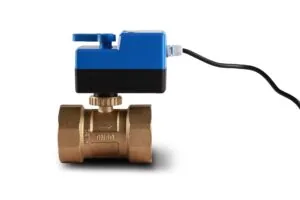
V2016 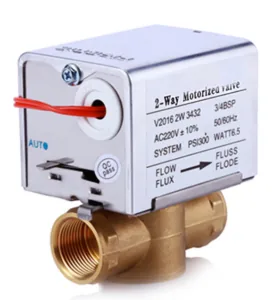


| Model | DF220 |
|---|---|
| Valve Type | 2-way motorized ball valve |
| Nominal Diameter | DN20 (3/4") |
| Body Material | Brass forging |
| Power Supply | AC 220 V ±10 %, 50/60 Hz |
| Power Consumption | 3 VA / 6 VA (open/close only) |
| Motor Type | Synchronous / reversible synchronous |
| Running Time | 15 s |
| Output Torque | 15 kgf·cm |
| Nominal Pressure | 1.6 MPa |
| Close-off Pressure | < 0.6 MPa |
| Leakage | ΔP < 0.4 MPa (bubble-tight) |
| Connection | G-thread (BSPP) |
| Medium | Chilled/hot water or 50 % ethylene glycol |
| Medium Temperature | 2 °C ~ 90 °C |
| Lead Wire | 700 mm |
| Dimensions (L × H) | 68 mm × 105 mm |
| Kv Value | 4.0 |
| IP Rating | IP54 |
DF220 is a two-way motorized ball valve for hydronic HVAC circuits. It pairs a synchronous electric actuator with a brass-forged valve body, so the water path is a quarter-turn ball rather than a seat-and-plug arrangement: the ball’s through bore lines up with the pipe when the valve is open and rotates 90° across the flow when it closes. That geometry gives a straight, unobstructed passage in the open position, which is why ball valves are the usual choice for terminal on/off duty in chilled and hot water systems.
The actuator is the part that decides how the valve behaves in service. It uses a synchronous motor that drives the ball to the end position and then stops receiving power, because a built-in limit switch interrupts the circuit once the ball has arrived. The valve is normally supplied at the factory-open position; other positions are available on request for projects that prefer a different starting state. Chilled water, hot water and 50 % ethylene-glycol mixtures are all acceptable media, which covers the standard terminal loop and the frost-protection versions of it.
In an on/off water circuit the valve is not asked to regulate; it is asked to admit or stop flow, and the thermostat or controller that owns the zone decides when. The controller closes a contact, the actuator rotates the ball through 90°, the limit switch opens the motor circuit, and the valve waits in that position until the contact changes state again. Because the motor is de-energised at both ends of the travel, the actuator produces no standing heat in a ceiling void or a cabinet, and the consumption figure quoted for this model applies mainly to the seconds in which the valve is actually moving.
Two pressure figures matter when the valve is selected against a pump. Nominal pressure describes the body’s structural rating, while close-off pressure describes the differential the actuator can hold closed — the point at which the water pressure on the ball would push it open again. A pump whose available head at the branch exceeds the valve’s close-off capability will push flow through a closed valve, so the two numbers have to be compared branch by branch rather than at the riser. The leakage class of this valve is specified as bubble-tight up to a stated differential, which is the standard the market expects for a metal-seated ball valve on terminal water control.
The valve is offered with a G-thread (BSPP) connection in DN20, and its Kv characterises the flow capacity of that bore. Kv is the volume of water in cubic metres per hour that passes through the valve at a differential pressure of one bar, so it is the number that connects the valve to the coil: too small and the coil never sees its design flow, too large and the valve loses authority over the circuit and the branch behaves as if it had no control at all. For a fan coil or a small air handling unit coil, the exercise is quick — the control valve Cv / Kv calculator converts a design flow and an allowable pressure drop into the required Kv, and the closest standard valve is chosen from there.
The actuator and body are separable, which suits maintenance: the actuator can be changed without breaking into the water system. For projects that need more than a single terminal valve, the DN32–DN50 QBO3A covers larger branches, and the stroke-type V6016 and V2016 series cover DN15–DN25 where a lower-cost switched valve is acceptable.
Chilled and hot water on/off control at fan coil units is the primary duty, followed by air handling unit water coils, underfloor heating and cooling manifolds, and flow switching between a heat pump and a boiler. The valve is also used to isolate a zone that is out of service while the rest of the building continues to run, which is a common requirement in hotels and rental apartments between tenancies.
Because the actuator is rated IP54, it tolerates the dusty and slightly damp conditions found in ceiling voids and plant cupboards, and because the medium range covers both chilled and hot water, one valve type serves the whole terminal population of a building rather than two separate specifications. The valve is compatible with the DANRENS AC801, AC803, AC806 and AC808 series controllers, so a terminal loop can be assembled and commissioned as one package.
Work through four questions. First, is the circuit two-pipe or four-pipe, and does the water side need only on/off control or genuine modulation — a ball valve of this type is an on/off device, and a project that needs proportional control requires a modulating valve and a proportional output, as set out in HVAC control signals: 0–10 V and 4–20 mA. Second, what is the design flow at the coil, which decides the required Kv and therefore the valve size.
Third, what differential pressure will the pump present at that branch, because that figure has to sit below the valve’s close-off capability with some margin. Fourth, what voltage is available at the terminal: this model takes AC 220 V, which is the common case where the thermostat switches mains directly. Selection practice in more detail, including the mistakes that show up after handover, is in electric valve selection for HVAC: a practical guide and electric valve vs. solenoid valve. The wider family sits under the electric valve range.
Mount the valve so that the actuator sits above the horizontal centreline of the pipe. Water finds its way into whatever is below the pipe, whether from condensate on a cold line or from a joint that weeps later, and an actuator mounted underneath collects it. Use standard G-thread fittings only — tapered threads deform a parallel-thread port and will not seal reliably. Flush the pipeline before the valve is fitted, because swarf and scale that reach the ball are the usual cause of a valve that will not seal after a season of operation, and leave the actuator outside any pipe insulation so that it can reject its own heat.
Electrically, terminate the supply and switch conductors according to the terminal diagram and isolate the circuit before working on it. The four field precautions that prevent most call-backs — orientation, thread type, flushing and insulation — are covered in motorized ball valve installation: 6 field precautions. If a valve fails to respond or fails to seal after commissioning, electric ball valve troubleshooting works through the causes in the order they are usually found.
The actuator contains a limit switch that interrupts the motor circuit once the ball reaches fully open or fully closed. The motor therefore draws nothing while the valve sits in position, which removes the standing heat a stalled synchronous motor would generate and avoids the mechanical wear that comes with holding against a stop. Power is consumed mainly during the few seconds of travel.
A motorized ball valve uses a motor to turn a ball and holds its position without power, so it draws current only while moving and can be left open or closed indefinitely. A solenoid valve holds its position electromagnetically, which means it consumes power continuously in its energised state and releases when the coil is de-energised. For terminal water control the ball valve’s low standing consumption and its tolerance of dirty water are the usual reasons it is preferred; the trade-offs are compared in electric valve vs. solenoid valve: differences and how to choose.
It is not recommended. Keep the actuator above the horizontal centreline so that condensate, drips and any future weep at a joint run past the valve rather than into it. Orientation is the first of the precautions covered in motorized ball valve installation.
Kv is the flow of water in cubic metres per hour that passes through a fully open valve at a differential pressure of one bar. It is the link between the valve and the coil: the required Kv follows from the coil’s design flow and the pressure drop the circuit can afford, and the control valve Cv / Kv calculator does that conversion. A valve that is far too large for the branch will lose authority and control the coil poorly even though it is technically “bigger”.
It is compatible with the DANRENS AC801, AC803, AC806 and AC808 series controllers, which supply the switched output that drives the actuator. Because the valve is a simple two-wire-plus-common device from the controller’s point of view, it can also be driven by any thermostat or controller with a suitable relay output for mains voltage.
DANRENS supplies the DF220 as a catalogue item and as part of project packages in which the terminal valve, the thermostat and the sensors are specified together. Actuator labelling and packaging can be adapted for OEM orders, and the factory-open position can be specified where a project’s control logic expects the valve to start open. Where a project includes several terminal types, send the coil duties, branch sizes and the available control voltage, and a valve schedule can be prepared against it. Our OEM/ODM capability is described in your reliable OEM/ODM partner for smart HVAC controls.
The DF220 is a DN20 (3/4″) two-way motorized brass ball valve for chilled or hot water at 2–90 °C, rated 1.6 MPa with bubble-tight shut-off up to 0.4 MPa differential pressure.
AC 220 V ±10%, 50/60 Hz synchronous drive, 15 kgf·cm output torque, Kv 4.0, and a 15 s running time; the lead wire is 700 mm.
Compare your design flow with its Kv 4.0 in the valve Cv/Kv calculator; if your duty is larger, the QBO3A covers DN32–DN50.
Yes. DANRENS provides OEM and ODM service: logo, packaging and hardware or software customization can be arranged based on your order quantity. See how the engagement works in our OEM / ODM guide, or send your requirements through the contact page — our team replies within 24 hours.
Tell us your required quantity and specifications — we reply within 24 hours.