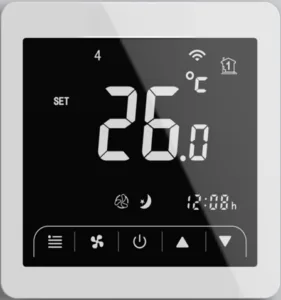
AC006 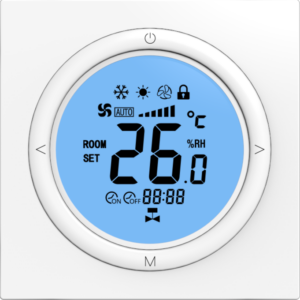


| Model | AC306 |
|---|---|
| Power Supply | AC 100-240 V, 50/60 Hz |
| Control Type | Touch button |
| Switching Type | On/Off relay |
| Accuracy | ±1 °C |
| Display | Black backlit LCD with icons |
| Fan Speed | 3-speed + Auto |
| System Modes | Cool / Heat / Vent / Auto / Sleep |
| Communication | RS-485 Modbus RTU optional |
| IP Rating | IP30 |
| Application | FCU / Central air conditioning |
AC306 is a touch-button fan coil unit (FCU) thermostat built around a full glass faceplate. The black backlit LCD shows room temperature, set point, fan speed and the active mode as icons rather than text, and four capacitive keys — Mode, Fan, Up and Down — are printed directly on the glass, so the front of the unit is one unbroken surface with nothing to catch dust or to press by accident.
The model targets interiors where the thermostat is visible design rather than utility: hotel rooms, show flats, executive offices and apartments where a wall device with mechanical buttons would look out of place. Functionally it is a complete FCU zone controller. It reads room temperature with its own sensor, compares the reading with the set point, and then drives the fan relay and the water-side valve together, with cooling, heating, ventilation, auto and sleep modes available to the occupant.
The control loop is the standard fan-coil sequence. When the room drifts above the set point in cooling mode, the thermostat energises the fan at the chosen speed and opens the chilled-water valve; as the room approaches the set point it closes the valve and lets the fan run on briefly to distribute the air already cooled in the coil. Heating mode repeats the logic on the hot-water circuit, and ventilation mode runs the fan alone so a space can be flushed with outdoor air without any heating or cooling demand.
The sleep mode is the added function on this model. It gives the occupant an overnight profile that sits alongside cool, heat, vent and auto, so a guest can leave the unit running through the night without resetting the set point by hand before sleeping. Because the display carries the mode as a single icon, the state of the thermostat is legible across a room without needing to walk up to it — a practical point in guest accommodation, where the person reading the display is often not the person who set it.
Two choices should be made at order stage. The optional RS-485 Modbus RTU board converts the AC306 from a standalone room controller into a supervised device on a building management network, so set points can be written and status read centrally — the difference between managing a floor of rooms from a workstation and walking it. The faceplate and key layout can also be varied for OEM and project orders, which is usually the interest of hotel groups that want the same button arrangement across several property brands.
On the installation side, the relay outputs drive a fan and a water-side valve, covering two-pipe systems that change over seasonally and four-pipe systems with separate coils. The unit is rated IP30 and is intended for dry indoor walls; it is not a plant-room or wash-down device.
The obvious fit is hospitality: hotel guest rooms and suites, serviced apartments and resort units, where the glass faceplate survives cleaning cycles and the child-lock keeps a curious guest from rearranging the settings. The same qualities suit premium office fit-outs, show flats and high-end residential central air-conditioning, particularly where the interior designer has specified a limited palette of finishes.
Because the footprint is the standard 86 × 86 mm wall box and the supply accepts AC 100–240 V, the AC306 is equally usable in refurbishment work: where an older controller has failed but the box and conduit are sound, the wiring can be retained and only the terminal device replaced. In such projects the flat glass front is usually the reason this model is chosen over a tactile alternative, since the new thermostat sits beside existing finishes that may be many years old.
Start with the water side. A two-pipe fan coil changes over between seasons, a four-pipe fan coil carries separate coils, and the thermostat has to be able to drive whichever arrangement the project has; relay outputs cover both, provided the valve is switched rather than modulated. If the valve or the fan is to be modulated, a proportional output is required instead, and the signal in question has to be chosen deliberately — the options are compared in HVAC control signals: 0–10 V and 4–20 mA.
Then settle supervision. If the rooms will be connected to a BMS, the RS-485 Modbus board must be ordered with the thermostats, not after the fact. Finally, decide how the unit should look and feel in the hand: the AC306 uses four discrete glass keys with tactile feedback at each press, which suits users who expect a positive acknowledgement, while a bar-style key is preferred where the surface should read as unbroken. Water-side sizing follows from the coil load, and the FCU water flow calculator converts that load into a flow rate and an indicative valve Kv. Other faceplates in the family are collected under the FCU thermostat range.
Mount the thermostat 1.2–1.5 m above finished floor level on an interior wall that is representative of the room, away from direct sun, door draughts and local heat sources such as lamps, televisions or supply diffusers. Placement is the single largest cause of a room controller that reports the wrong temperature, and no setting in the menu can compensate for it. Isolate the circuit before wiring, use the standard 86 × 86 mm wall box, and keep mains conductors separated from any RS-485 pair along their run.
Terminal details for two-pipe and four-pipe fan coils are given in central AC thermostat installation and wiring; the checks that should follow first power-up, including fan-step verification and valve response, are in the FCU thermostat wiring and commissioning field guide.
Both are black-display touch thermostats with the same control duties and the same wall box footprint. The AC306 uses four discrete glass keys and adds a sleep mode; the AC308 uses an illuminated bottom touch bar in place of the four keys, which gives the faceplate a continuous surface below the display. The choice is a matter of how the device should look and be operated rather than of capability.
Yes. There are no key gaps, membranes or moving parts on the front, so routine cleaning with a damp cloth does not disturb the settings and there is nothing to wear out. The keys are capacitive and are read through the glass.
No. Room temperature is measured by the sensor built into the unit. Where the thermostat cannot be sited so that it sees the occupied zone — for example behind a wardrobe or beside a supply diffuser — a remote-sensing arrangement or a separate wall sensor is a better solution than a poorly positioned thermostat.
Yes, if the optional RS-485 Modbus RTU board is specified at order stage. Without it the thermostat operates locally: the weekly timer and holiday mode work as usual, but set points and status cannot be read from the BMS.
The AC006 has a round faceplate with a humidity readout; the AC3385 is a square display with a clock for scheduled operation; the AC818 is a push-button model for cost-sensitive retrofits.
DNARENS supplies the AC series as catalogue products and as OEM/ODM projects. Faceplate branding, button labelling and packaging can be adapted for project and OEM orders, and the thermostat can be shipped together with the matching motorized valves and sensors so that the whole terminal loop is sourced from one place. Faceplate finishes in particular are worth discussing early, because they are usually tied to an interior specification that is fixed before the HVAC package is ordered. Send the room count, pipe configuration, control requirement and faceplate direction, and a model list can be confirmed against your schedule. More on our OEM/ODM capability is in your reliable OEM/ODM partner for smart HVAC controls.
Tell us your required quantity and specifications — we reply within 24 hours.