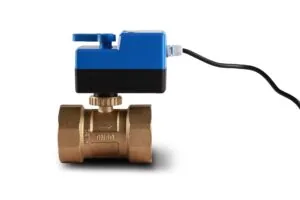
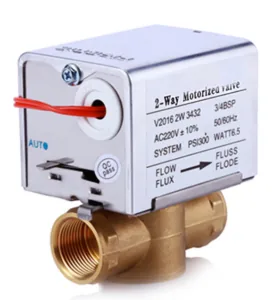
DF220 


| Model | V6016 |
|---|---|
| Valve Type | 2-way / 3-way motorized valve (series) |
| Operation | On/Off (Open/Close) |
| Power Supply | AC 120/220/240 V, 50/60 Hz |
| Power Consumption | 2 VA |
| Motor Type | Hysteresis synchronous motor |
| Acting Force | 10.5 N ±10% |
| Stroke | 3 mm (max 5 mm) |
| Full Opening Time | 10 s |
| Full Closing Time | 5 s |
| Connection Thread | British Standard Thread BSP |
| Nominal Diameter | DN15~DN25 (1/2″~1″) |
| Kv Range | 0.63~6.5 |
| Medium Temperature | 2~94 °C |
| Pressure Rating | 2.5 MPa |
| Differential Shut-off Pressure | 0.06~0.25 MPa (model dependent) |
| Protection Class | IP40 |
| Ambient Temperature | 0~+60 °C (work), -20~+65 °C (storage) |
| Max Relative Humidity | No condensation |
| Body Material | Brass |
| Valve Stem | Brass |
| Actuator Ring | O-shaped EPT |
| Valve Rod | AISI303 stainless steel |
| Spring | Stainless steel |
| Seal Material | Plastic EPT |
V6016 is a compact motorized valve for HVAC water-loop control, built around a hysteresis synchronous motor and a brass body with a stainless-steel valve rod. Where a ball valve turns a sphere, this is a stroke valve: the motor drives a stem along a short linear travel and closes a plug against a seat. The result is a quiet, low-cost switched valve that handles the great majority of fan coil and small air handling duties, and the same series is available in two-way and three-way configurations across DN15 to DN25.
The three-way version is the reason this series exists in many projects. A diverting three-way valve changes the path of the water rather than merely stopping it, which is what a two-pipe changeover system needs when a single coil has to be fed from the chiller in summer and the boiler in winter, or what a bypass arrangement needs in order to keep flow through a pump constant while a terminal coil is satisfied.
A hysteresis synchronous motor rotates at a speed locked to the supply frequency and, through a small reduction mechanism, converts that rotation into a short linear stroke. The stem moves the plug through roughly the length of the seal travel, so the valve has a small, fixed, repeatable motion rather than a quarter turn. That arrangement has two practical consequences worth knowing before the valve is specified.
The first is that closing force is limited by what the motor can develop through the mechanism. A plug pressed onto a seat will hold against a differential, but the differential it can hold is smaller than a ball valve of the same size can manage, so the valve’s published shut-off differential has to be compared with the actual pressure the pump will present at that branch. The second is quietness: the short stroke, the low mass of the moving parts and the sealed gear train make this type noticeably quieter in a ceiling void than a larger actuator turning a heavy ball, which is why it remains the default choice above a hotel guest room.
Three choices define a V6016 order. The first is the configuration: two-way, which simply admits or stops flow, or three-way diverting, which routes flow from a common port to one of two others and is what a changeover or bypass circuit requires. The second is the size and its associated Kv, spread across DN15 to DN25 so that the same valve family can be matched to a range of coil loads simply by choosing the right bore — the control valve Cv / Kv calculator converts a coil’s design flow and allowable pressure drop into the Kv to ask for.
The third is the differential shut-off rating, which varies by model within the series because the stem force has to overcome the pressure acting on the plug. Some models hold a lower differential than others, so on a branch where the pump head is significant, the model with the higher rating is the one to select rather than the one whose Kv happens to be closest to the calculated figure. The supply is the standard AC range with 50/60 Hz, so the valve suits either a panel-supplied or a mains-derived switched output.
The series is used for fan coil unit water-side on/off control, air handling unit heating and cooling coils, small commercial hydronic zoning, and HVAC retrofit and new-build projects where a compact, low-noise valve is required. The three-way variant extends that to seasonal changeover on two-pipe systems and to bypass control where the pump must keep a minimum flow regardless of how many terminals are calling.
Because the body and stem are brass with a stainless-steel rod and the actuator is compact, the valve fits the restricted space inside a fan coil casing, which is where many of these are installed. In retrofit work the BSP threaded connection is the standard thread in the market, so an existing union can generally be reused and the work is confined to the valve position rather than the pipework around it.
Decide first whether the function is switch or divert. If a coil simply needs water or no water, a two-way valve is correct. If the circuit has to change over between a chiller and a boiler, or maintain flow through a pump while a terminal is satisfied, a three-way diverting valve is required, and the piping arrangement has to be drawn accordingly.
Then size from flow. Calculate the required Kv from the coil duty, choose the nearest standard bore, and check that the model’s differential shut-off rating exceeds the differential the pump will present at that branch — remembering that an oversized valve loses authority over the circuit and controls the coil poorly even though it is nominally the “safer” choice. Finally confirm the control signal. These valves take a switched open/close command, which is what a thermostat or a zone controller provides; proportional control needs a different valve and a proportional output, and the signal options are compared in HVAC control signals: 0–10 V and 4–20 mA. Larger branches are served by the QBO3A ball valve and fail-safe duties by the V2016 spring-return series; the group is collected under the electric valve range, with selection practice in electric valve selection for HVAC.
Confirm the flow direction against the arrow on the valve body before the union is tightened, because a stroke valve installed against its intended direction will not close reliably once the loop is under pressure. Check that the supply voltage matches the actuator rating, leave clearance above the actuator for removal and service, and install with the actuator upright or horizontal — an inverted mounting places the gear train and the cable entry where condensate can reach them. Isolate the power before installation or maintenance, and flush the piping system before commissioning so that debris does not reach the seat.
The general precautions for motorized valves, including thread preparation and insulation clearance, are covered in motorized ball valve installation: 6 field precautions, and where a valve will not respond to its command the diagnostic sequence in electric ball valve troubleshooting applies to the actuator end of the problem as much as to the ball type.
Choose the stroke valve for standard terminal duty: it is compact, quiet, inexpensive and available in a three-way diverting version that the ball valves in this catalogue are not. Choose a ball valve such as the DF220 or QBO3A where the branch has a high differential to hold against or where the lowest possible pressure drop matters, because a quarter-turn ball has a straight-through bore and a higher close-off capability.
The two-way valve has an inlet and an outlet and either passes water or stops it. The three-way diverting valve has a common port and two alternative ports: flow is directed to one or the other, which lets a single coil be fed from a chiller in one season and a boiler in the other, or keeps water circulating through a bypass while a terminal is satisfied.
Two numbers decide it. The Kv follows from the coil’s design flow and the pressure drop the circuit can afford, and it determines the bore. The differential shut-off rating then has to exceed the pump’s differential at that branch with margin; because the rating varies across the series, a model can be perfectly sized on flow and still be the wrong choice if it cannot hold the branch closed.
IP40 means the enclosure is protected against solid objects larger than 1 mm and has no water-ingress protection. In practice the valve belongs where it is dry — ceiling voids, fan coil casings, plant cupboards and risers — and not in a wash-down area or in a position where condensate can drip onto the actuator.
The stroke mechanism opens against the flow and closes with it. Opening has to move the plug into the stream and work against the water, while closing is assisted by the pressure difference across the plug, so the closing stroke completes in less time. That asymmetry is normal for this valve type and is part of what the published times describe.
DANRENS supplies the V6016 series for catalogue orders and for project packages in which the terminal valves, thermostats and sensors are specified together. Two-way and three-way configurations, size, actuator labelling and packaging can all be adapted for OEM and project business, and valves can be delivered as a schedule matched to the coil duties on the drawing rather than as individual purchases. Send the coil loads, branch sizes, whether changeover or bypass is involved, and the available control voltage, and a valve list can be prepared against the project. More on our OEM/ODM work is in your reliable OEM/ODM partner for smart HVAC controls.
The V6016 is a 2-way or 3-way on/off motorized valve for chilled or hot water (2–94 °C), with a brass body rated 2.5 MPa — a common choice for FCU zones and small AHU circuits.
DN15–DN25 (1/2″–1″) BSP connection, Kv values of 0.63–6.5, and an actuator on AC 120/220/240 V that opens fully in about 10 s and closes in about 5 s with a 3 mm stroke.
Run your design flow through the valve Cv/Kv calculator and pick the size whose Kv covers your duty; the electric valve category shows the whole range.
Yes. DANRENS provides OEM and ODM service: logo, packaging and hardware or software customization can be arranged based on your order quantity. See how the engagement works in our OEM / ODM guide, or send your requirements through the contact page — our team replies within 24 hours.
Tell us your required quantity and specifications — we reply within 24 hours.