
Overview
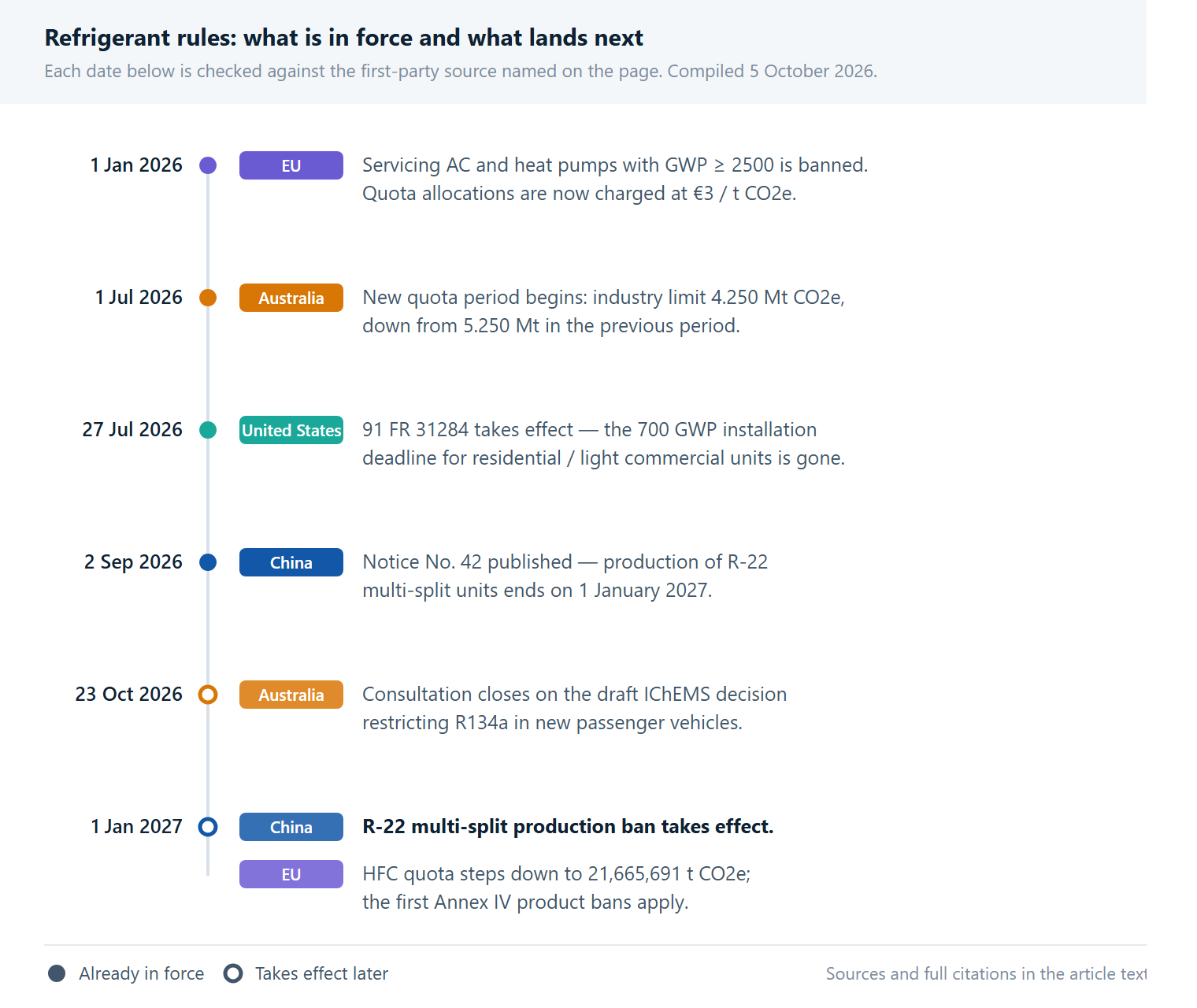
Read the HVAC trade press this autumn and you will come away with one impression: refrigerant rules are tightening everywhere, all at once. That is not what the primary sources show. Between January and September 2026, regulators in four major markets did five different things — one tightened, one was reversed, one paused, one was still only a draft, and one took effect in the European Union.
This update covers only what has actually changed, with the instrument and the date for each. Every claim below is traceable to the regulation, the official journal entry or the regulator’s own publication, and the full citation list is at the foot of the page. It ends with what the changes mean for the components that sit inside those systems — valves, actuators and sensors — because that is where a regulatory change becomes a specification problem.
Key points
- China has the only hard new deadline this quarter. Notice No. 42, published 2 September 2026, prohibits production of R-22 multi-split (VRF) units from 1 January 2027. It bans production only — not sale or import.
- China’s ban is a formality, not a shock. More than 98 % of the domestic multi-split sub-sector already uses R410A and the remaining HCFC-22 is under 0.1 % of the volume being phased out. The next Chinese deadline, 1 January 2030, is the one with reach.
- The United States went the other way. The 700 GWP installation deadline for residential and light commercial equipment was withdrawn entirely, effective 27 July 2026. The manufacture and import date of 1 January 2025 is unchanged.
- The EU did not cut its HFC quota in 2026. 2025 and 2026 share the same cap of 42,874,410 t CO2e. The step-down is 1 January 2027, and that is also when the first Annex IV product bans apply.
- There is still no R-410A production stop date in the US. R-410A may continue to be manufactured and imported for servicing existing equipment, subject to a labelling condition.
- Australia’s vehicle-AC restriction is a draft. The consultation runs to 23 October 2026 and the proposed effect date is 1 January 2028.
China: R-22 multi-split production ends on 1 January 2027
The Ministry of Ecology and Environment published Notice No. 42 of 2026, “Announcement on Prohibiting the Production of Multi-Split Air-Conditioning (Heat Pump) Units Using HCFC-22 as Refrigerant”, dated 2 September 2026. The operative text is two clauses long.
| Item | What the notice says |
|---|---|
| Instrument | Ministry of Ecology and Environment Notice No. 42 of 2026 (index 000014672/2026-00301) |
| Published | 2 September 2026, issued by MEE alone; NDRC and MIIT are copied, not co-issuing |
| Takes effect | 1 January 2027 |
| Prohibits | Production of multi-split (VRF) air-conditioning and heat pump units that use HCFC-22 as refrigerant |
| Does not cover | Sale, import or the servicing of already-installed equipment — the notice names production only |
| Scope | Defined by four standards in the annex: GB/T 18837, GB/T 25857, JB/T 11966 and JB/T 14064 |
| Legal basis | Regulations on the Administration of Ozone-Depleting Substances, plus the National Programme for Implementing the Montreal Protocol (2025–2030) |
| Not in the text | No transition period, no stock provisions and no penalty clauses — those sit in the underlying regulations, not in this notice |
Two numbers from the explanatory note that accompanied the earlier draft put the change in proportion. More than 98 % of the domestic multi-split sub-sector already uses R410A, and the HCFC-22 still in use in that sub-sector is around 15 tonnes — under 0.1 % of the total quantity being phased out. The notice closes a small remaining gap; it does not redirect a supply chain.
What matters more is what sits behind it. The National Programme sets out that HCFC production and consumption are to be cut by 97.5 % of the baseline by 2030, with 2.5 % retained for refrigeration and air-conditioning servicing, and that from 1 January 2030 it becomes prohibited to produce industrial and commercial refrigeration and air-conditioning equipment that uses HCFCs as refrigerant. That is the deadline with real scope across the industry.
Two other Chinese instruments took effect this year without much notice. GB/T 4706.32-2024, the national adoption of IEC 60335-2-40 covering the safety of heat pumps, air conditioners and dehumidifiers, applied from 1 August 2026. Three light-industry standards on the installation, servicing, transport and production of room air conditioners using flammable refrigerants — QB/T 4835-2026, QB/T 4975-2026 and QB/T 4976-2026 — applied from 1 September 2026. If you buy equipment in China for a flammable-refrigerant charge, those are the standards the factory is now working to.
United States: the installation deadline was withdrawn
This is the change most summaries have not caught up with. The rule restricting high-GWP refrigerants in residential and light commercial air conditioning and heat pumps — 88 FR 73098, published 24 October 2023 — carried two different dates, and they are frequently conflated.
- Manufacture and import of systems using a regulated substance with a GWP of 700 or greater: prohibited from 1 January 2025. Unchanged.
- Installation of those systems: the original 1 January 2025 date was first delayed to 1 January 2026, and then withdrawn entirely by a final rule published 26 May 2026 (91 FR 31284), effective 27 July 2026.
The practical result is written into the regulation text at 40 CFR 84.54(c)(1): a residential or light commercial system whose specified components were all manufactured or imported before 1 January 2025 may continue to be installed, with no compliance deadline. Units already in a distributor’s warehouse are not stranded, and the sale-through date that many contractors were working towards no longer exists.
Separately, the same 2026 rule adjusted several other sector dates — semiconductor and industrial-process chillers, cold storage and lab equipment among them — and EPA has not created a production stop date for R-410A anywhere in this rulemaking. R-410A may still be manufactured and imported for servicing existing equipment; those components carry a label reading “For servicing existing equipment only.” HFCs remain available after 2036 at 15 % of baseline. For 2026 the HFC production and consumption caps stand at 60 % of baseline, the 2024–2028 step.
The direction of travel is unchanged; the enforcement date is simply later than most timelines show. A2L equipment remains the mainstream choice for new installations, and the underlying listing of R-32 and R-454B as acceptable substitutes is unchanged.
European Union: a plateau year, a service ban and a new fee
Regulation (EU) 2024/573 has applied since 11 March 2024 and it is the reason many 2026 summaries expect a quota cut. There is not one. The maximum quantity of HFCs placed on the market is the same in 2025 and 2026 — 42,874,410 t CO2e — against a 2015 base value of 176,700,479 t CO2e. The next step-down is 1 January 2027, to 21,665,691 t CO2e. A Commission implementing decision of 30 October 2024 states the position directly: the maximum quantities should be the same in 2025 and 2026 and decline from 2027.
What did change on 1 January 2026 is more consequential for anyone holding an installed base:
- A servicing prohibition. From 1 January 2026, using Annex I fluorinated greenhouse gases with a GWP of 2500 or more to maintain or service air-conditioning equipment and heat pumps is prohibited, with an exemption for reclaimed and recycled gas running to 1 January 2032.
- A charge on quota. From the same date, HFC quota allocations are charged at €3 per tonne of CO2e. It is a cost line, not a prohibition, but it feeds into refrigerant prices.
The 2027 date is the busy one: the quota step-down and the first Annex IV product bans arrive together. If a specific product is on your order list, read the Annex IV entry for its capacity band and GWP threshold rather than a summary — the thresholds step by equipment type and rated capacity, and the servicing prohibition above is already binding on existing equipment in a way that the placement bans are not.
Australia, New Zealand and Canada: quotas step down, one rule is still a draft
Australia moved into a new quota period on 1 July 2026 under the Ozone Protection and Synthetic Greenhouse Gas Management Act 1989 and its 1995 Regulations. The industry limit for 2026–2027 is 4.250 million tonnes CO2e, down from 5.250 Mt in the previous period, on the way to 1.607 Mt from 2036 — an 85 % reduction against baseline. Note that this is a cap on bulk imports, which constrains price and availability rather than banning any particular system.
The vehicle-air-conditioning story circulating since September is a proposal, not a rule. Australia has notified the WTO of a proposed IChEMS scheduling decision on hydrofluorocarbons (G/TBT/N/AUS/202, notified 21 September 2026). Consultation closes 23 October 2026; the proposed effect date is 1 January 2028. As drafted it would restrict imports of new passenger vehicles using HFCs with a GWP of 150 or more — which excludes R134a, at a GWP of about 1430 — while leaving HFCs in place for larger mobile air conditioning, with a review after 2032. Treat any claim that Australia has restricted R134a in vehicles as premature.
Canada works through a supply cap rather than equipment bans for this category. Under SOR/2016-137, the annual consumption allowance runs at 90 % of baseline for 2019–2023, 60 % for 2024–2028, 30 % for 2029–2033, 20 % for 2034–2035 and 15 % from 2036, against a base of 18,008,795 t CO2e. The product restrictions in Schedule 1.1 cover standalone and centralised refrigeration, condensing units, chillers (GWP ≤ 750 from 1 January 2025) and mobile refrigeration — residential air conditioners and heat pumps are not on the list, and there is no R-410A installation prohibition. If you supply Canada and assumed it mirrored the US 700 GWP rule, it does not.
New Zealand holds its bulk HFC import limit flat for 2026 at 856,500 t CO2e, the same as 2025, before dropping to 695,900 in 2027. Importers need a permit and participate in the emissions trading scheme.
The changes side by side
| Market | Instrument | What happened in 2026 | Next node |
|---|---|---|---|
| China | MEE Notice No. 42 of 2026 | Published 2 Sep; R-22 multi-split production ends 1 Jan 2027 | 1 Jan 2030 — HCFC ban widens to industrial and commercial RAC equipment |
| United States | 91 FR 31284; 40 CFR 84.54 | From 27 Jul, no installation deadline for pre-2025-built 700+ GWP equipment | 2029 — HFC cap drops to 30 % of baseline |
| European Union | Reg. (EU) 2024/573 | From 1 Jan, servicing AC and heat pumps with GWP ≥ 2500 banned; €3/t CO2e quota charge | 1 Jan 2027 — quota halves and Annex IV bans begin |
| Australia | OPSGGM Act 1989; IChEMS draft | New quota period from 1 Jul at 4.250 Mt CO2e | 23 Oct — consultation closes; proposed vehicle rule 1 Jan 2028 |
| Canada | SOR/2016-137 | No change — 2024–2028 cap holds at 60 % of baseline | 2029 — cap drops to 30 % |
| New Zealand | Ozone Layer Protection Regs 1996 | Import limit held flat at 856,500 t CO2e | 2027 — limit falls to 695,900 |
Five things the summaries keep getting wrong
Each of these appears repeatedly in industry newsletters and reseller guidance. The right-hand column is what the source document actually says.
| Common claim | What the source says |
|---|---|
| “The EU cut its HFC quota in 2026.” | No. 2025 and 2026 have the same cap, 42,874,410 t CO2e. The cut is 1 January 2027. |
| “The US banned R-410A.” | No production stop date exists. R-410A may still be made and imported for servicing, labelled “For servicing existing equipment only”. |
| “The US installation deadline was 1 January 2026.” | That date existed briefly and was withdrawn by the rule effective 27 July 2026. There is no installation deadline for equipment built before 1 January 2025. |
| “Australia restricted R134a in cars in 2026.” | Still a draft. Consultation closed 23 October 2026; proposed effect date 1 January 2028. |
| “China’s R-22 ban covers air conditioners generally.” | It covers production only, and only multi-split units as defined by the four standards in the annex. |
What this changes for valves, sensors and actuators
None of these instruments regulate a valve or a thermostat directly. What they change is the installed base those components sit in — and that is a purchasing question, not a legal one.
The US withdrawal extends the life of R-410A systems. Equipment built before 1 January 2025 can now be installed with no deadline, and R-410A remains available for servicing. Both effects point the same way: a larger, longer-lived installed base of R-410A equipment, and sustained demand for the controls that go with it — two-position and modulating valves, actuators, and room controllers sized for that pressure and temperature envelope. If you supply that market, this is the change with the most direct effect on next year’s order book.
The EU servicing prohibition pushes repair towards replacement. When the gas itself cannot be used for maintenance, the economics of a mid-life repair change: a contractor facing a leak in an older system has fewer options than a recharge. Work moves towards replacing terminal units, and a terminal unit replacement carries its valves, actuators and controls with it. This is the one 2026 change that reaches equipment already installed, which makes it the one most likely to generate aftermarket demand before the placement bans bite in 2027.
Refrigerant determines what the valve has to do. Every refrigerant change alters the pressure–temperature relationship and the density the system works with, and a valve selected on one refrigerant is not automatically correct on another. Sizing has to start from the duty point and the pressure drop again, not from the pipe size. Our control valve sizing calculator returns the Cv or Kv a valve needs from flow and pressure drop, and the nearest standard body — the number to specify from. On the terminal side, the FCU flow calculator works the same problem from coil heat load and water ΔT.
A2L systems need detection, and detection means sensors. Refrigerant detection is now part of the equipment design rather than an option: a leak sensor wired to a mitigation control that runs the indoor blower to dilute the charge and shuts the compressor down. The sensor and its control board are line items. On the building side, the same tightening raises the value of the measurement layer generally — see our temperature, humidity and CO2 transmitters for what that looks like in a specification.
Isolation and two-position duty become more visible. Where a system is being modified rather than replaced, on/off isolation is often the cheapest way to bring an existing circuit back into service. That is squarely solenoid valve territory, and it is worth reading alongside the wider comparison of electric valves and solenoid valves before you pick the type for a given line. For motorised control duty, the electric valve range covers the modulating side, and damper actuators cover the air side of the same transition.
What to check on your next order
- Ask which obligation the rule creates. Most of these instruments regulate placing equipment on the market, not the supply of spare components. A valve shipped as a service part is usually outside a placement ban — but the labelling conditions may still apply, so confirm rather than assume.
- Separate the manufacture date from the installation date. The US rule turns entirely on this distinction, and it is the single most misread point in circulation. A component’s build date, not the date it is fitted, decides what applies.
- Confirm the refrigerant the control will actually see. State the refrigerant and the expected operating pressure and temperature in the enquiry. A controller or valve specified for one refrigerant and installed on another is a commissioning fault waiting to happen.
- Check whether detection is required at system level. On A2L equipment, ask who supplies the detection and mitigation function, and whether the sensor is inside your scope or the OEM’s.
- Check the market’s own timeline, not the region’s reputation. Canada does not mirror the US 700 GWP rule, and New Zealand is not on Australia’s schedule. Four markets, four different dates.
Summary
The 2026 refrigerant picture is not a uniform tightening. China published the only new hard deadline, and it closes a gap that is already almost closed. The United States relaxed an installation deadline while leaving its manufacture and import rules intact. The European Union held its HFC quota flat but made servicing with high-GWP gas illegal on equipment that is already installed. Australia stepped its import cap down and left the vehicle rule as a draft. Canada and New Zealand did nothing new.
For anyone specifying or supplying components, the useful consequences are concrete. The American installed base of R-410A equipment just got longer-lived, which sustains demand for the controls around it. The European servicing prohibition shifts repair towards replacement, which carries valves, actuators and sensors with it. And in every market, a change of refrigerant sends you back to the duty point to re-size the valve rather than to the pipe schedule to look it up.
Work with DNARENS
Regulatory change lands on components. DNARENS manufactures the parts that sit inside these systems — fan coil thermostats, motorised valves and actuators, damper actuators, solenoid valves and temperature, humidity and CO2 transmitters — from our own facility in Quanzhou, China, with OEM and ODM support and 100% function testing before shipment.
If you are re-specifying controls because a refrigerant or a compliance date changed, these are the ranges to start from:
- Motorised control valves and actuators for modulating water-side duty, and solenoid valves for on/off isolation and two-position circuits.
- Damper actuators for the air side, and FCU thermostats for terminal control.
- Temperature, humidity and CO2 transmitters for the measurement layer, including detection duties on A2L equipment.
Related reading: the 2026 A2L refrigerant transition, what an HVAC control system is, and electric valve vs solenoid valve.
Send us the refrigerant, the duty point and the target market and our engineers will reply within 24 hours with matched models and a quotation: contact the DNARENS engineering team.
Free engineering tools, no sign-up: control valve sizing calculator, FCU flow calculator, damper actuator torque calculator and sensor range selector — all at danrens.com/tools.
Sources
Primary documents behind the standards, regulations and figures in this article. Links open in a new tab.
- Announcement on Prohibiting the Production of Multi-Split Air-Conditioning (Heat Pump) Units Using HCFC-22 as Refrigerant (Notice No. 42 of 2026)
- National Programme for the Implementation of the Montreal Protocol (2025-2030)
- Phasedown of Hydrofluorocarbons: Reconsideration of Certain Regulatory Requirements Promulgated Under the American Innovation and Manufacturing Act (91 FR 31284)
- Phasedown of Hydrofluorocarbons: Restrictions on the Use of Certain Hydrofluorocarbons Under the American Innovation and Manufacturing Act of 2020 (88 FR 73098)
- 40 CFR Part 84 Subpart A, Section 84.7 - Phasedown of Hydrofluorocarbons
- F-gas legislation - Regulation (EU) 2024/573 and implementing acts
- Ozone-depleting Substances and Halocarbon Alternatives Regulations (SOR/2016-137), Section 65.06
- HFC quota allocation determination for the 2026-2027 period (F2025L00848)
- Hydrofluorocarbon phase-down frequently asked questions
- Proposed IChEMS scheduling decision on hydrofluorocarbons (WTO TBT notification G/TBT/N/AUS/202)
- Ozone Layer Protection Regulations 1996, Schedule 6 - limits on allocation of new bulk HFCs
- GB/T 4706.32-2024, Safety of household and similar electrical appliances - Particular requirements for heat pumps, air conditioners and dehumidifiers
Need Help Specifying or Sourcing?
Tell us your system type, required quantity and target market — our engineers reply within 24 hours with matched models and a quotation.
Back to Blog
