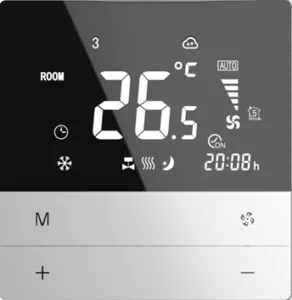
AC3385 


| Model | AC308 |
|---|---|
| Power Supply | AC 100-240 V, 50/60 Hz |
| Control Type | Touch button |
| Switching Type | On/Off relay |
| Accuracy | ±1 °C |
| Display | Black LCD with white icons |
| Fan Speed | 3-speed + Auto |
| System Modes | Cool / Heat / Vent / Auto |
| Communication | RS-485 Modbus RTU optional |
| IP Rating | IP30 |
| Application | FCU / Central air conditioning |
AC308 is a touch-controlled fan coil unit (FCU) thermostat whose interface is a single illuminated bar along the bottom edge of the faceplate. The black LCD shows room temperature and the active mode in white icons above the bar, and the bar itself carries the menu, fan, power and temperature keys, so the front of the unit stays flat and symmetrical while remaining easy to operate in a dark room.
The model is built for the same duty as the rest of the AC series: it measures room temperature with its own sensor, compares the reading with the set point, and drives the fan relay and the water-side control together across cooling, heating, ventilation and auto modes. What distinguishes it is the arrangement of the controls — an unbroken bar rather than separate keys — and a schedule set that includes an energy-saving programme alongside the weekly timer and holiday mode.
Operation follows the standard fan-coil sequence. In cooling mode, when the room rises above the set point, the thermostat starts the fan at the selected speed and opens the chilled-water valve; as the room approaches the set point, the valve closes and the fan continues briefly to distribute the air already cooled in the coil. Heating mode repeats the logic against the hot-water circuit, and ventilation mode runs the fan alone so that a room can be flushed with outdoor air without any heating or cooling demand. Three fan speeds plus automatic fan cover both quiet operation and fast recovery after a window has been left open.
The scheduling functions are what make the model useful in commercial operation rather than only in a home. The weekly timer sets occupied and unoccupied periods; holiday mode suspends the normal programme for a defined absence; the energy-saving schedule narrows the set point band while the space is unoccupied so that a fan coil in an empty office or an unlet apartment does not condition the room to occupied comfort levels through the night. Together they address the largest avoidable energy load in a room-by-room zoned building, which is the conditioning of rooms nobody is using.
The main order-stage option is the RS-485 Modbus RTU communication board, which places the thermostat on a building management network so that set points can be written and status read centrally instead of at each wall. Projects that intend to report room conditions to a BMS or a hotel management system should specify it with the order; it is not a field addition afterwards.
The relay outputs drive the fan and a water-side valve, which suits two-pipe installations that change over seasonally and four-pipe installations where the thermostat switches separate coils. The unit is rated IP30 for dry indoor walls. Faceplate labelling and the button legend can be varied for OEM and project orders where a customer’s own branding or language is required.
The illuminated bottom bar is the practical argument for this model in guest accommodation and hospitality interiors: the keys are readable in a dark room without turning on a light, while the faceplate itself remains a plain black surface in daylight. That combination suits hotel guest rooms, serviced apartments and boutique residential projects where the thermostat sits opposite the bed.
Commercially, the energy-saving schedule and holiday mode make the AC308 a reasonable fit for offices, clinics, classrooms and other premises with predictable occupancy, and the standard 86 × 86 mm footprint with a universal AC 100–240 V supply means it can replace a failed controller in a retrofit without touching the existing box or conduit.
The first question is the water side: whether the fan coil is two-pipe or four-pipe, and whether the valve will be switched or modulated, because that decides between relay outputs and a proportional signal. The second is supervision — if the building will be managed from a BMS, order the communication option with the thermostats. The third is scheduling: if the building has a fixed occupancy pattern, a model with a weekly timer and holiday mode will pay for itself by not conditioning empty rooms, and the same logic applies to the choice of set point band.
The fourth question is interface. The AC308 places all control on one illuminated bar; the AC306 uses four discrete glass keys with a tactile press; the AC006 uses a round display with a humidity readout; the AC3385 adds a clock to the display. Where the water side is to be sized, the FCU water flow calculator converts coil load into flow rate and indicates the valve Kv to match, and the wider selection logic is discussed in temperature controller selection for HVAC systems.
Site the thermostat 1.2–1.5 m above the floor on an interior wall that represents the room, clear of direct sunlight, door draughts and nearby heat sources such as lamps or supply air diffusers. Position determines whether the reading is representative of the occupied zone, and nothing in the configuration menu can correct a unit that is measuring the wrong air. With the circuit isolated, wire the fan and valve outputs and keep the mains conductors away from any communication pair over the length of the run.
Terminations for two-pipe and four-pipe fan coils are described in central AC thermostat installation and wiring, and the commissioning sequence after power-up — fan steps, valve response and mode changeover — is set out in the FCU thermostat wiring and commissioning field guide. Where the thermostat forms part of a larger control scheme, what is an HVAC control system shows how the room level fits beneath the plant level.
The keys on the AC308 are arranged along one continuous illuminated bar rather than as four discrete zones. The faceplate reads as an unbroken surface, the key legends are backlit so the unit can be operated without switching on a light, and cleaning requires no attention to gaps between individual keys.
The weekly timer switches the fan coil between occupied and unoccupied operation according to a programme set for each day. Holiday mode suspends that programme for a period of absence. The energy-saving schedule narrows the comfort band while a space is unoccupied, so an empty room is kept from drifting to extremes without being conditioned to full occupied comfort. In practice these three functions are the main reason a scheduled thermostat reduces running cost in a building with predictable occupancy.
No. Room temperature is measured by the sensor built into the thermostat, so the device needs only its supply wiring plus the fan and valve connections. If the thermostat cannot be mounted where it sees the occupied air, a separate wall or duct sensor is the correct answer rather than relocating the thermostat into an unsuitable position.
Yes, when the optional RS-485 Modbus RTU board is included. Without it the thermostat is a standalone local controller: the schedule works, but no external system can read or reset it.
The switching type is on/off relay, which is the standard for fan-coil terminals whose fan is stepped and whose water-side valve is opened or closed rather than positioned. Projects that require modulation need a proportional output instead, and the trade-offs between the common analogue signals are discussed in HVAC control signals: 0–10 V and 4–20 mA.
DNARENS supplies the AC series for catalogue and OEM/ODM orders. For this model the usual customisation is the button legend and faceplate labelling, together with packaging, which lets a hotel group or an equipment manufacturer present the thermostat as part of its own product set. The thermostats can be supplied with the matching motorized valves and sensors so that the terminal loop arrives as one package with one interface to commission. Send the room count, pipe configuration, control signal and any BMS requirement, and the model list can be checked against your schedule. More on our OEM/ODM work is in your reliable OEM/ODM partner for smart HVAC controls.
Tell us your required quantity and specifications — we reply within 24 hours.