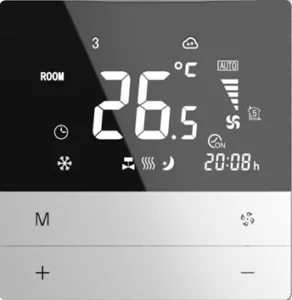
AC3385 


| Power Supply | 100–240 VAC, 50/60 Hz |
|---|---|
| Self-Consumption | <1.5 W |
| Timing Error | <1% |
| Load Current | 1 A inductive / 2 A resistive |
| Temp. Range | 10–30 °C |
| Control Accuracy | ±1 °C |
| Dimensions | 86 × 86 × 15 mm |
AC818 is a push-button fan coil unit (FCU) thermostat for residential and light commercial installations. Instead of a touch surface it uses tactile buttons with a clear LCD backlight behind them, so an occupant can feel each press and confirm it without looking at the display — the operating convention most people already know from the thermostat the unit replaces.
Electrically it is the most flexible member of the AC series to install. The supply input accepts 100–240 VAC at 50/60 Hz, so the same unit covers both nominal mains voltages with no link, jumper or dual-stock arrangement, and the 86 × 86 mm wall plate matches the box used by the previous generation of controllers. It is designed for two-pipe and four-pipe fan coil systems and carries a built-in timing function alongside the usual temperature control duties.
The thermostat reads room temperature with its own sensor and compares it with the set point. In cooling mode it starts the fan and opens the water-side valve when the room rises above the set point, then closes the valve as the room approaches it, letting the fan distribute the air already cooled inside the coil. Heating mode repeats the sequence on the hot-water circuit. The settable range spans 10–30 °C with ±1 °C control accuracy, which is the range and tolerance a fan-coil zone actually needs — below 10 °C the coil is not the limiting factor in cooling a room, and above 30 °C the coil cannot deliver useful cooling anyway.
Two electrical ratings deserve attention at design stage because they decide what the thermostat can switch directly. The relay output is rated 1 A inductive and 2 A resistive, and the difference matters in practice: a fan motor is an inductive load whose starting current exceeds its running current, while a resistive load draws a steady current. The lower inductive figure is the one to compare against the fan nameplate, and it is comfortably above what a terminal fan coil fan motor draws. Self-consumption is below 1.5 W, so a floor of thermostats adds little to the building’s standing load. The internal timing circuit is specified to better than 1 % error, which keeps scheduled switching on programme rather than drifting over a season.
The AC818 is a standalone local controller rather than a network device: there is no RS-485 Modbus option in this model, so where a project needs set points and status read from a building management system, a model from the AC series with the communication board is the right choice instead. What the AC818 offers in exchange is a simple, low-cost terminal with the widest supply tolerance in the family and a push-button interface that needs no explanation.
Because the wall plate is the standard 86 × 86 mm size and the supply covers both low and high mains, one stocked unit serves residential replacements, light commercial fit-outs and mixed-voltage projects. Faceplate labelling can be varied for OEM and project orders where a customer’s own branding is required.
The natural applications are residential central air-conditioning and light commercial terminals: apartments, villas, small offices, shops and guest houses, together with the retrofit work that makes up a large share of fan-coil demand. In refurbishment the deciding factors are usually the wall plate and the supply — the new thermostat fits the existing box, accepts whatever mains voltage the building provides, and does not need a communication cable that the conduit cannot carry.
The push-button interface also suits installations where the user population is not technically inclined or where the thermostat is operated with gloves or wet hands. A tactile press that can be felt is more reliable in those conditions than a capacitive surface, and there are no settings hidden behind gestures.
Decide first what the water side needs. A two-pipe fan coil changes over between heating and cooling across seasons; a four-pipe fan coil has separate coils and needs a thermostat able to drive both. The AC818 covers both because the relay outputs switch the fan and the valve, so it suits any terminal whose valve is opened and closed rather than positioned.
Decide second whether the building will be supervised. If set points and room conditions must appear on a BMS or a hotel management system, a communicating model is required and the RS-485 Modbus option must be ordered with the thermostats. If the rooms run independently, the AC818 is the simpler and cheaper answer — there is no network to configure and nothing to address.
Decide third how the unit will be operated. Where users expect a tactile button, choose this model; where the faceplate is part of an interior design specification, a glass or bar-key model will look more appropriate, and the alternatives are collected under the FCU thermostat range. Water-side sizing is a separate calculation: the FCU water flow calculator turns coil load into flow rate and gives an indicative valve Kv, and the broader selection process is set out in our temperature controller selection guide.
Mount the thermostat 1.2–1.5 m above the floor on an interior wall that represents the room, away from direct sunlight, door draughts and local heat sources. The built-in sensor measures the air where the thermostat is, so a unit mounted beside a lamp, above a radiator or inside a draught from the corridor will report a temperature that has little to do with the occupied zone. Isolate the circuit before wiring, confirm the fan and valve conductors against the terminal diagram, and use the standard 86 × 86 mm wall box.
Wiring layouts for two-pipe and four-pipe fan coils are given in central AC thermostat installation and wiring, including the mechanical-versus-LCD comparison that usually arises in retrofit work, and the post-installation checks are covered in the FCU thermostat wiring and commissioning field guide. Where a fault appears after commissioning rather than during it, the troubleshooting section of our control-system guide works through the usual causes.
The relay output is rated 1 A inductive and 2 A resistive. A fan motor is an inductive load, so the 1 A figure is the one to compare with the fan nameplate current; the higher resistive rating applies to non-inductive loads. For terminal fan coil fans this is ample, and larger fans or pumps should be switched through a contactor rather than directly.
Yes. The thermostat drives the fan and the water-side valve through relay outputs, which covers two-pipe systems that change over seasonally and four-pipe systems whose separate coils are switched by the thermostat.
The settable range is 10–30 °C with ±1 °C control accuracy. That is the practical band for a fan-coil zone: a fan coil cannot hold a room much below the range when outdoor conditions are extreme, and occupants rarely ask for anything above it.
No — this model is a standalone local controller without a communication port. Where BMS supervision is required, specify an AC series model with the optional RS-485 Modbus RTU board. The AC818 is intended for installations where each room runs independently and the only requirement is reliable local control.
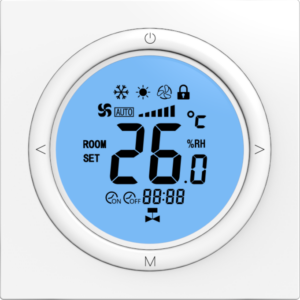
The AC006 and AC3385 are touch models with a humidity readout and a clock respectively; the AC306 and AC308 use glass and bar touch keys for contemporary interiors.
DANRENS supplies the AC series for catalogue and OEM/ODM business. The AC818 is a frequent subject for private-label work because its simple interface and wide supply tolerance make it suitable for a distributor’s own range, and faceplate labelling, button legends and packaging can all be adapted. The thermostat can also be supplied together with the matching motorized valves so that the terminal loop is specified as one package. Send the room count, pipe configuration and voltage, and the model list can be confirmed against your schedule. Further detail on our OEM/ODM work is in your reliable OEM/ODM partner for smart HVAC controls.
The AC818 is a push-button FCU thermostat for central air-conditioning terminals. It covers a 10–30 °C setpoint range with ±1 °C control accuracy and a timing error below 1%, in a compact 86 × 86 × 15 mm housing.
It switches up to 1 A inductive or 2 A resistive load and runs on 100–240 VAC, 50/60 Hz, drawing less than 1.5 W.
Yes. DANRENS provides OEM and ODM service: logo, packaging and hardware or software customization can be arranged based on your order quantity. See how the engagement works in our OEM / ODM guide, or send your requirements through the contact page — our team replies within 24 hours.
Use the FCU flow calculator to size the valve, then confirm the AC818's 1 A inductive / 2 A resistive contact rating covers your actuator. More controllers are listed in the FCU thermostat category.
Tell us your required quantity and specifications — we reply within 24 hours.